
How to Use AI for Competitive Analysis: A 10-Step Workflow

Knowing what your competitors are doing is no longer optional. If another brand changes its pricing, launches a new feature, starts ranking for your target keywords, updates its landing page, or gets mentioned by AI search tools before you do, that information can directly affect your traffic, leads, and sales.
The problem is that manual competitor research takes too much time. You open competitor websites, check their blogs, scan pricing pages, review LinkedIn posts, compare SEO keywords, analyze ads, and still feel like you missed something important.
That is where AI changes the process.
In this guide, you will learn how to use AI for competitive analysis in a practical way. We will cover the tools, prompts, templates, and workflow you can use to monitor competitors, find content gaps, compare offers, track market positioning, and turn raw data into useful business decisions.
This is not about spying, scraping private data, or copying competitors. Good competitive analysis is about understanding the market clearly so you can position your product, content, and messaging better.
What Is AI Competitive Analysis?
AI competitive analysis is the process of using artificial intelligence tools to collect, organize, summarize, and interpret competitor data.
Instead of manually reading dozens of pages and spreadsheets, AI can help you:
- Summarize competitor website changes
- Compare pricing pages
- Identify SEO keyword gaps
- Analyze product messaging
- Track competitor content topics
- Monitor social media and customer sentiment
- Create battlecards for sales teams
- Find gaps in your own website or offer
- Track brand visibility in AI search engines like ChatGPT, Gemini, Claude, Perplexity, and Google AI Overviews
The goal is simple: turn scattered competitor information into clear decisions.
For example, instead of saying:
“Competitor A is posting a lot on LinkedIn.”
AI can help you say:
“Competitor A is targeting mid-market SaaS teams with security-focused messaging, publishing three product-led LinkedIn posts per week, and pushing a free audit CTA. Their strongest angle is risk reduction, while our current messaging is still focused only on speed.”
That second version is useful. It tells your marketing, SEO, sales, and product teams what to do next.
What AI-Powered Competitor Analysis Brings to the Table
AI-powered competitor analysis brings speed, pattern recognition, summarization, and automation to a task that used to be slow and manual.
Here is what AI adds:
1. Faster Research
AI tools can summarize large amounts of competitor information in minutes. You can analyze blog posts, landing pages, product pages, reviews, ads, and social media updates without reading every word manually.
2. Better Pattern Detection
AI can identify repeated messaging patterns across competitor pages. For example, it can detect whether a competitor is positioning itself around price, speed, security, enterprise support, automation, or ease of use.
3. Continuous Monitoring
Competitor research should not be a one-time project. AI-powered monitoring tools can alert you when competitors update pricing, launch new products, publish new content, change website copy, or release announcements.
4. Clearer Sales Battlecards
Sales teams need quick answers, not long research documents. AI can turn competitor research into short battlecards with positioning points, objection handling, comparison tables, and “when to use this angle” notes.
5. Smarter SEO and AI Search Strategy
Traditional SEO competitor analysis looks at rankings, backlinks, and keywords. Modern AI search also requires tracking whether your brand appears in AI-generated answers. AI visibility tools can help you see where competitors are being mentioned and where your brand is missing.
Traditional vs AI-Powered Competitor Analysis Tools
Traditional competitor analysis tools are useful, but they often require manual interpretation. AI-powered tools go further by summarizing, classifying, and recommending actions.
| Area | Traditional Competitor Analysis | AI-Powered Competitor Analysis |
|---|---|---|
| Data collection | Manual checks, spreadsheets, SEO exports | Automated monitoring, summaries, alerts |
| Website tracking | You check pages yourself | AI detects and explains changes |
| SEO analysis | Keyword and backlink reports | Keyword gaps plus content recommendations |
| Social listening | Mentions and engagement metrics | Sentiment, themes, complaints, positioning |
| Sales enablement | Static competitor docs | Dynamic battlecards and deal-specific insights |
| AI search visibility | Usually not included | Tracks mentions in ChatGPT, Gemini, Perplexity, AI Overviews |
| Output | Raw data | Insights, summaries, recommendation |
The biggest difference is this: traditional tools show you data, while AI-powered competitor analysis tools help explain what the data means.
What Should You Monitor on Competitor Websites?
You do not need to monitor every page. Focus on pages that reveal strategy.
High-Value Competitor Pages to Monitor
- Homepage
Look for positioning changes, new taglines, new customer segments, and updated CTAs. - Pricing page
Track plan changes, discounts, free trials, new enterprise options, and feature limits. - Product or feature pages
Watch for new features, integrations, use cases, and technical claims. - Comparison pages
See how competitors position themselves against other brands, including yours. - Blog and resource pages
Identify content topics, SEO strategy, thought leadership, and keyword targeting. - Case studies
Learn which industries, customer types, and outcomes competitors are promoting. - Changelog or release notes
Useful for SaaS, AI tools, apps, and software companies. - Careers page
Hiring patterns can reveal expansion into new markets, product areas, or departments. - Partner and integration pages
These can show ecosystem strategy and business development direction. - Landing pages and ad pages
Useful for understanding campaign angles, offers, and conversion messaging.
A good rule: monitor any page that would matter if it changed tomorrow.
Best AI Tools for Analyzing Competitors
Here are practical AI tools for analyzing competitors, organized by the data and workflow they support.
How this shortlist was evaluated: tools were selected for distinct jobs—SEO gaps, estimated traffic, website-change alerts, product-marketing intelligence, social listening, and AI-assisted synthesis. This is an editorial workflow comparison, not a controlled accuracy benchmark. Traffic, audience, and visibility figures from third-party platforms are estimates; validate important conclusions with first-party evidence and more than one source.
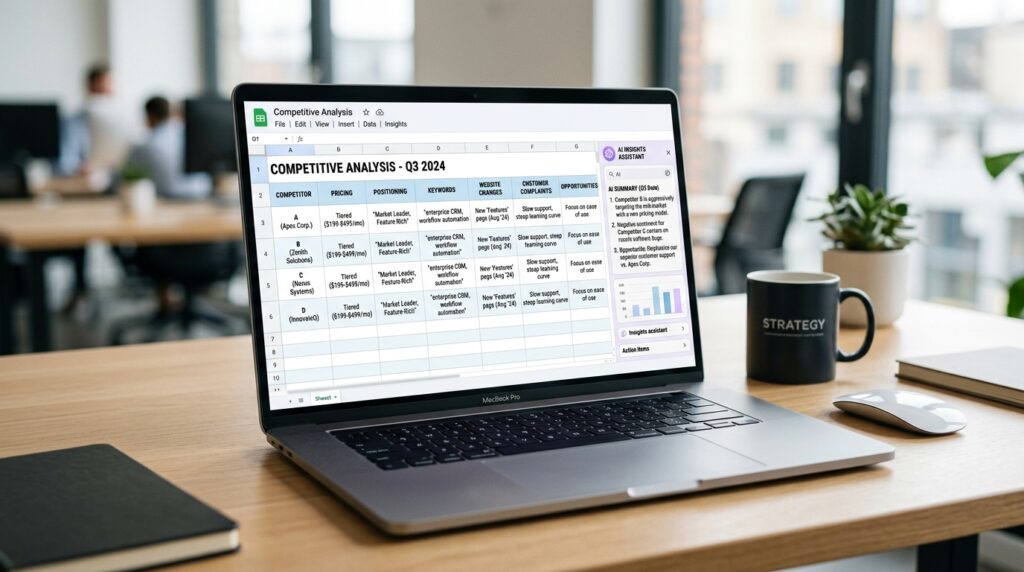
1. Semrush
Best for SEO, traffic research, keyword gaps, content analysis, and AI search visibility.
Use Semrush when you want to know:
- Which keywords competitors rank for
- What pages drive their organic traffic
- Which content topics they cover
- How your brand compares in search visibility
- Whether competitors appear more often in AI search results
Best use case:
A blog or SaaS company can use Semrush to find competitor keyword gaps, then create better content targeting those missing topics.
2. Ahrefs
Best for backlink analysis, SEO competitor research, content gaps, and brand visibility research.
Use Ahrefs when you want to know:
- Which websites link to competitors
- Which competitor pages attract backlinks
- What keywords your competitors rank for but you do not
- Which content assets are earning authority
- How competitors appear across search and AI visibility tools
Best use case:
A website owner can compare their domain with three competitors and find keywords where competitors rank but their site does not.
3. Similarweb
Best for market intelligence, traffic benchmarking, audience insights, and channel comparison.
Use Similarweb when you want to know:
- Estimated competitor traffic
- Top acquisition channels
- Referral sources
- Audience behavior
- Market share signals
- Competitor performance across digital channels
Best use case:
A product marketing team can compare traffic sources and see whether competitors are winning through organic search, paid search, referrals, social, or direct traffic.
4. Crayon
Best for competitive intelligence teams, sales enablement, competitor monitoring, and battlecards.
Use Crayon when you want to:
- Track competitor website changes
- Monitor pricing, messaging, and product updates
- Build sales battlecards
- Alert sales teams about competitor moves
- Turn raw competitor data into usable sales insights
Best use case:
A B2B sales team can use Crayon to keep reps updated when a competitor changes pricing or launches a new feature.
5. Klue
Best for competitive enablement, battlecards, win-loss insights, and sales team support.
Use Klue when you want to:
- Centralize competitor knowledge
- Create battlecards
- Collect sales feedback
- Analyze win-loss patterns
- Help reps position better against competitors
Best use case:
A SaaS company can use Klue to help sales reps answer “Why us instead of Competitor X?” with clear proof points.
6. Brandwatch
Best for social listening, consumer intelligence, sentiment tracking, and brand perception.
Use Brandwatch when you want to know:
- What customers say about competitors
- Which complaints appear repeatedly
- How people compare your brand with others
- Which topics are trending in your market
- How sentiment changes over time
Best use case:
A consumer brand can analyze reviews and social posts to find competitor weaknesses customers keep mentioning.
7. Visualping
Best for competitor website change monitoring.
Use Visualping when you want to monitor:
- Pricing page changes
- Product page updates
- New landing page copy
- Competitor announcements
- Feature table changes
- Terms, policy, or documentation updates
Best use case:
A SaaS founder can monitor five competitor pricing pages and receive alerts when plans, limits, or CTAs change.
8. Perplexity, ChatGPT, Gemini, and Claude
Best for summarizing research, comparing messaging, creating tables, generating prompts, and extracting insights from public information you provide.
Use these AI assistants when you want to:
- Summarize competitor pages
- Compare product positioning
- Create competitor matrices
- Draft sales battlecards
- Analyze reviews
- Generate SEO content gap ideas
- Turn data exports into action plans
Best use case:
You can paste competitor homepage copy into ChatGPT or Claude and ask it to compare positioning, audience, claims, proof points, and missing opportunities.
Top Tools for Product Marketing Analytics
If you are building a product marketing workflow, competitor research should connect with messaging, positioning, SEO, sales, and customer insights. These are the Top tools for product marketing analytics to consider:
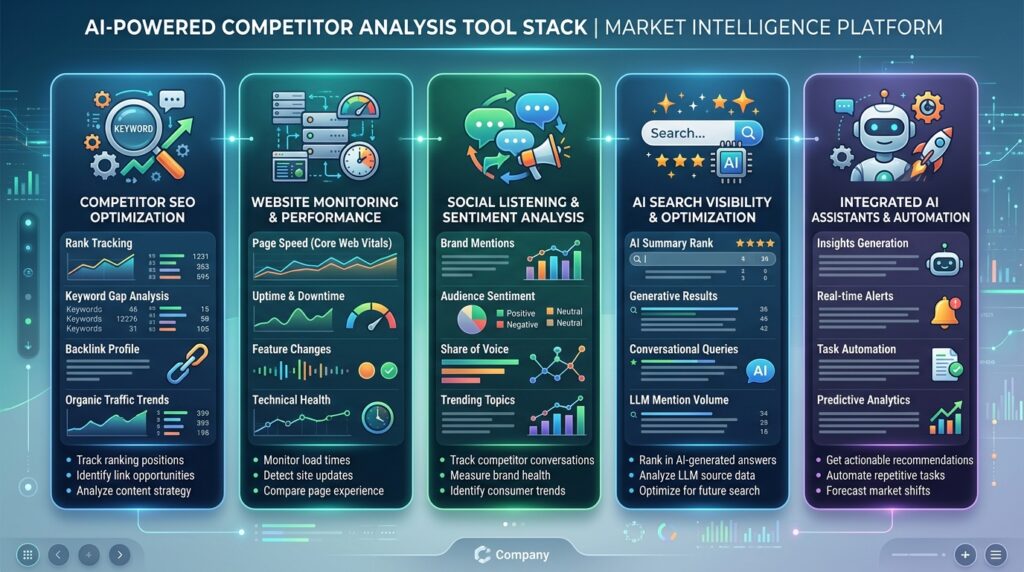
For SEO and Content Gaps
- Semrush
- Ahrefs
- SE Ranking
- Surfer SEO
- AlsoAsked
For Market and Traffic Intelligence
- Similarweb
- SparkToro
- Google Trends
- Statista
- Exploding Topics
For Competitive Enablement
- Crayon
- Klue
- Kompyte
- Notion or Airtable for internal research hubs
For Website Monitoring
- Visualping
- Distill
- ChangeTower
- Browse AI
For Social and Consumer Intelligence
- Brandwatch
- Sprout Social
- Hootsuite
- Reddit search
- G2 and Capterra reviews
For AI Search Visibility
- Semrush AI Visibility tools
- Ahrefs Brand Radar
- SE Ranking AI Visibility Tracker
- Profound
- Peec AI
Do not buy every tool at once. Start with one SEO tool, one website monitoring tool, and one AI assistant. Then add advanced competitive intelligence software when the process becomes valuable enough.
How to Use AI for Competitive Analysis: Step-by-Step Workflow
Here is a practical workflow you can follow.
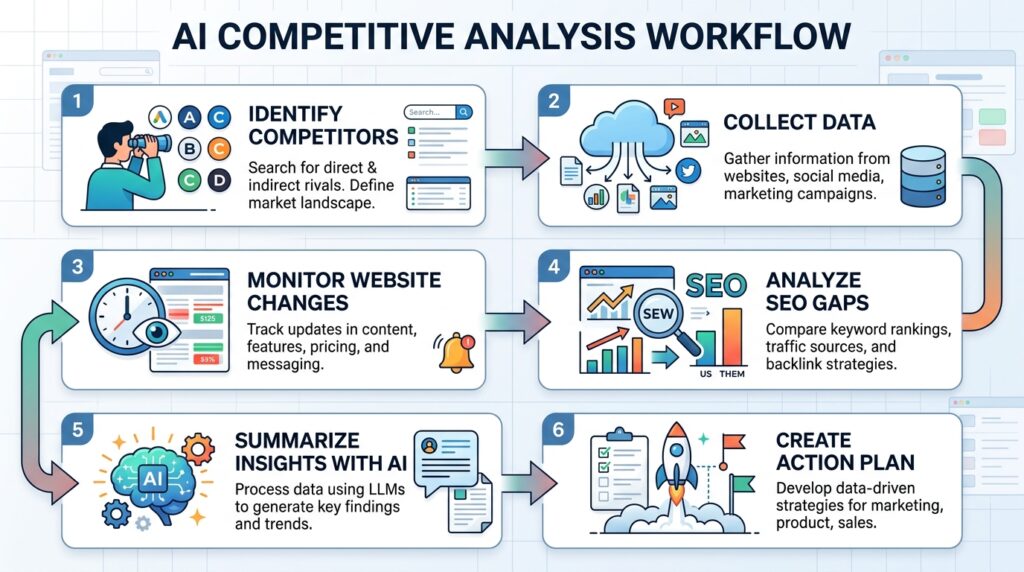
Step 1: Define Your Competitors
Most people make a mistake here. They only track direct competitors.
You should track four types of competitors:
Direct Competitors
These sell a similar product to the same audience.
Example:
If you run an AI writing tool, Jasper, Copy.ai, Writesonic, and ChatGPT-based writing platforms may be direct competitors.
SEO Competitors
These websites rank for the keywords you want, even if they do not sell the same product.
Example:
A blog ranking for “best AI tools for small business” may be an SEO competitor even if it is not a software company.
AI Search Competitors
These are brands that appear in ChatGPT, Gemini, Perplexity, Claude, or Google AI Overviews when users ask recommendation-style questions.
Example:
If users ask, “What are the best AI tools for competitor analysis?” and your competitor appears but you do not, that is an AI search visibility gap.
Alternative Solution Competitors
These solve the same problem in a different way.
Example:
A spreadsheet template, agency, consultant, or manual workflow can compete with your AI tool if it solves the same customer problem.
Step 2: Build a Competitor Tracking Sheet
Create a simple spreadsheet with these columns:
| Competitor | Website | Category | Main Offer | Target Audience | Pricing | Main CTA | SEO Strength | AI Search Mentions | Notes |
|---|---|---|---|---|---|---|---|---|---|
| Klue | klue.com | Enterprise Competitive Intelligence | AI-powered battlecards & market tracking | Enterprise Product Marketing & Sales Teams | Custom Enterprise (Seat-based) | Request a Demo | High | Frequent (Top CI tool) | Strong CRM integrations; high barrier to entry for smaller teams. |
| Crayon | crayon.co | Market Intelligence Platform | Automated competitor tracking & analysis dashboards | Mid-Market to Enterprise Product Marketers | Custom Annual Pricing | Get a Demo | High | Frequent | Excellent for tracking competitor pricing and messaging shifts. |
| Semrush (EyeOn) | semrush.com | SEO & Market Research Suite | EyeOn tool for automatic competitor website monitoring | Digital Marketers, SEOs, & Small Businesses | Freemium ($129+/mo for full suite) | Start Free Trial | Very High | Dominant | Great all-in-one suite but less focused on proprietary sales enablement. |
| Contify | contify.com | AI Market Intelligence | AI-aggregated news & multi-source competitor tracking | Strategy, Insights & Executive Teams | Custom Enterprise | Request Free Trial | Medium | Moderate | Strong custom feed configuration; uses NLP heavily for filtering. |
| SpyFu | spyfu.com | Competitor Keyword Research | Search marketing secret weapon (PPC/SEO history) | Growth Marketers & Boutique Agencies | Value-focused ($39 – $79/mo) | Search Now | High | Moderate | Highly affordable, hyper-focused on search ads and organic keywords. |
| Kompyte | kompyte.com | Sales Intelligence & CI | Real-time competitor tracking for sales enablement | Mid-Market Sales & Marketing Teams | Custom Subscription | Book a Demo | Medium | Moderate | Owned by Semrush; specializes heavily in live win-loss data. |
| Visualping | visualping.io | Website Change Detection | Visual screenshot monitoring of any webpage | Individual professionals up to Enterprise legal/marketing | Freemium ($10 – $100+/mo) | Start Monitoring | High | Low to Moderate | Broad utility tool, frequently used by marketers to catch pricing tweaks. |
Step 3: Analyze Competitor Positioning
Positioning tells you how competitors want customers to see them.
Check these areas:
- Headline
- Subheadline
- CTA
- Hero section
- Feature claims
- Proof points
- Testimonials
- Comparison pages
- Pricing language
- Customer logos
- Case studies
AI Prompt for Positioning Analysis
Copy and paste this prompt:
Act as a senior product marketing strategist. Analyze the following competitor homepage copy. Identify the target audience, core promise, positioning angle, emotional trigger, proof points, CTA strategy, and any weaknesses in the messaging. Then suggest how my brand can differentiate without copying them.
Competitor copy: [paste text]
My product: [describe your product]
My audience: [describe audience]
What to Look For
You want to find patterns such as:
- Are competitors selling speed?
- Are they selling affordability?
- Are they selling enterprise security?
- Are they selling ease of use?
- Are they targeting beginners or advanced teams?
- Are they using fear, convenience, authority, or growth as the main emotional driver?
This is where AI can save hours. It can quickly turn website copy into a positioning map.
Step 4: Run an SEO Keyword Gap Analysis
SEO competitor analysis shows what topics competitors own in search.
Use tools like Semrush, Ahrefs, or SE Ranking to find:
- Keywords competitors rank for
- Pages bringing them traffic
- Content gaps on your site
- High-intent commercial keywords
- Comparison keywords
- “Best tools” keywords
- FAQ-style keywords
- Long-tail informational keywords
Example
If your website is about AI tools, you may compare your site against competitors ranking for:
- best AI tools for analyzing competitors
- AI competitor analysis tools
- competitive analysis template
- AI tools for product marketing
- competitor monitoring software
- AI search visibility tools
Then create pages that answer those searches better than competitors.
AI Prompt for SEO Gap Analysis
Act as an SEO strategist. I will paste a list of competitor keywords. Group them by search intent: informational, commercial, comparison, template, and FAQ. Then suggest which keywords should become blog posts, tool pages, comparison pages, and FAQ sections. Prioritize low-competition, high-intent opportunities.
Keywords: [paste list]
Step 5: Track Competitor Website Changes
Competitor websites are full of signals. A pricing change, new CTA, new feature page, or updated comparison table can tell you where the market is moving.
Use a website monitoring tool to track:
- Pricing pages
- Product pages
- Comparison pages
- Feature pages
- Landing pages
- Changelogs
- Case studies
- Careers pages
AI Prompt for Website Change Analysis
Act as a competitive intelligence analyst. Compare the old and new version of this competitor page. Summarize what changed, why it matters, what business strategy it may signal, and what action our marketing, sales, or product team should consider.
Old version: [paste old copy]
New version: [paste new copy]
Example Output You Want
Not useful:
“The competitor changed their pricing page.”
Useful:
“The competitor added an enterprise plan, removed public pricing for advanced features, and changed the CTA from ‘Start free trial’ to ‘Contact sales.’ This suggests they may be moving upmarket. Sales should prepare for enterprise comparison questions, and marketing should create content around transparent pricing.”
That is real competitive intelligence.
Step 6: Analyze Competitor Content Strategy
Competitor blogs reveal their SEO and education strategy.
Look at:
- Blog categories
- Publishing frequency
- Long-form guides
- Comparison posts
- Use case pages
- Free templates
- Glossary pages
- Case studies
- Webinars
- Lead magnets
Content Analysis Prompt
Analyze this competitor blog. Identify their main content pillars, target audience, keyword intent, funnel stage, content gaps, and lead generation strategy. Then suggest 10 content ideas my site can publish to compete without copying.
Competitor blog URLs or titles: [paste list]
My website niche: [describe niche]
Practical Example
If competitors publish many “best tools” articles but have weak templates, you can create:
- A downloadable competitive analysis template
- Prompt library for competitor research
- Comparison tables
- AI search visibility checklist
- Step-by-step workflow guides
This gives you a stronger chance to rank and appear in AI-generated answers.
Step 7: Analyze Reviews and Customer Complaints
Reviews are one of the most underrated competitor research sources.
Check platforms like:
- G2
- Capterra
- Trustpilot
- Product Hunt
- App stores
- Chrome Web Store
- YouTube comments
- LinkedIn comments
Look for:
- Repeated complaints
- Missing features
- Pricing objections
- Support issues
- Onboarding problems
- Integration requests
- Performance issues
- Reasons users switch tools
AI Prompt for Review Analysis
Act as a product marketing analyst. Analyze these competitor customer reviews. Extract the most common complaints, praised features, switching triggers, buyer objections, and opportunities for my product positioning. Organize the findings into a table.
Reviews: [paste reviews]
Example
If many users complain that a competitor is powerful but too complicated, your messaging can focus on:
- Easier setup
- Faster onboarding
- Simpler dashboard
- Templates included
- Beginner-friendly workflow
This is better than guessing what customers care about.
Step 8: Monitor Competitor Social Media and Ads
Social media shows how competitors communicate in real time.
Track:
- LinkedIn posts
- X/Twitter posts
- YouTube videos
- TikTok content
- Instagram carousels
- Facebook ads
- Google ads
- Webinar promotions
- Founder posts
- Influencer partnerships
Social Media Analysis Prompt
Analyze these competitor social media posts. Identify the content themes, hooks, audience pain points, offers, CTAs, and engagement patterns. Then suggest what content angles my brand should test next.
Posts: [paste content]
What to Watch
- Are they using founder-led content?
- Are they pushing product demos?
- Are they educating beginners?
- Are they attacking a competitor?
- Are they using case studies?
- Are they focusing on AI, automation, price, or ROI?
- Which posts get the most comments?
Social content is often where a competitor tests messaging before updating the website.
Step 9: Track AI Search Visibility
Search is changing. People are no longer only using Google. They ask tools like ChatGPT, Gemini, Claude, Perplexity, and AI Overviews for recommendations.
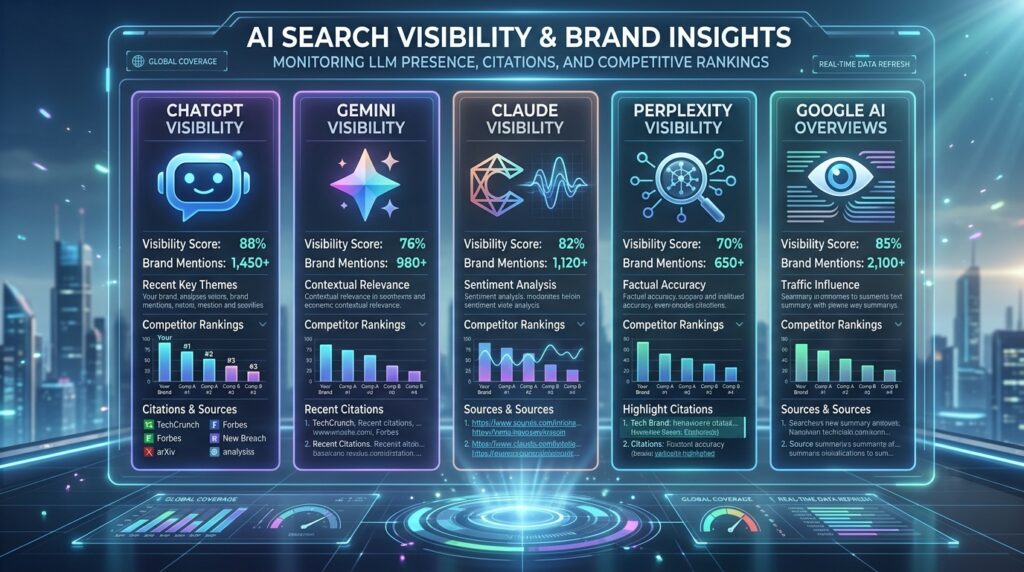
That means competitor analysis should include AI search visibility.
You need to test questions like:
- What are the best AI tools for competitive analysis?
- What are the best tools for product marketing analytics?
- Which AI tools help monitor competitors?
- What is the best competitor analysis software for small businesses?
- What are the best Semrush alternatives?
- What are the best tools for tracking competitor websites?
Then check:
- Which brands appear?
- Which pages are cited?
- What wording does the AI use?
- Are your competitors mentioned more than you?
- Are listicles, comparison pages, or official websites being cited?
- Is your website missing from AI-generated answers?
AI Search Visibility Prompt
Act as an AI search visibility analyst. I will give you a list of AI-generated answers for my target queries. Identify which brands are mentioned most often, which sources are cited, what content formats are being used, and what content my website should create to improve visibility.
AI answers: [paste answers]
My website: [describe website]
How to Improve AI Search Visibility
To appear in AI search results, create pages that are easy to understand, cite, and summarize.
Use:
- Clear definitions
- Comparison tables
- Tool lists
- Pros and cons
- FAQs
- Templates
- Step-by-step workflows
- Original examples
- Author experience notes
- Updated publication dates
- Strong internal linking
- Clear brand/entity mentions
AI tools tend to prefer content that directly answers the question and has clean structure.
Step 10: Turn Research Into an Action Plan
Competitor analysis is useless if it stays in a spreadsheet.
Every week or month, turn insights into actions.
Use this action table:
| Insight | Source | Why It Matters | Team | Action | Priority |
|---|---|---|---|---|---|
| Competitor added enterprise pricing | Pricing page alert | Moving upmarket | Sales/Product | Prepare enterprise comparison page | High |
| Competitor ranks for “AI competitor analysis tools” | SEO tool | Content gap | SEO | Publish guide + template | High |
| Users complain about difficult onboarding | Reviews | Positioning opportunity | Marketing | Create “setup in 10 minutes” messaging | Medium |
| Competitor appears in AI search results | AI visibility check | Brand visibility gap | SEO/GEO | Create citation-friendly tool comparison page | High |
This is the difference between research and strategy.
AI Competitive Analysis Template
Use this simple template for your own competitor research.
Competitor Profile
Competitor name:
Website:
Category:
Main product/service:
Target audience:
Pricing model:
Main CTA:
Top features:
Main promise:
Positioning angle:
Proof points:
Top SEO keywords:
Top content topics:
Social media channels:
Customer complaints:
Recent changes:
AI search visibility:
Opportunities for us:
Competitor Analysis Prompt Pack
Use these prompts to speed up your workflow.
Prompt 1: Competitor Website Summary
Summarize this competitor website page. Identify the audience, offer, key benefits, CTA, proof points, pricing signals, and differentiation angle. Then list what my brand can learn from it without copying.
Prompt 2: Pricing Page Analysis
Analyze this competitor pricing page. Identify the pricing strategy, plan structure, feature limits, upgrade triggers, free trial offer, enterprise positioning, and possible weaknesses.
Prompt 3: SEO Competitor Analysis
Analyze these competitor keywords. Group them by search intent and suggest content ideas my website should create to compete.
Prompt 4: Review Mining
Analyze these reviews and find repeated complaints, praised features, missing features, and customer switching triggers.
Prompt 5: Sales Battlecard
Create a sales battlecard comparing my product with this competitor. Include strengths, weaknesses, objection handling, proof points, and when to position our product as the better choice.
Prompt 6: AI Search Visibility Gap
Analyze these AI-generated answers. Identify which competitor brands appear, which sources are cited, and what content my website needs to publish to become more visible in AI search.
Prompt 7: Messaging Differentiation
Compare my homepage messaging with this competitor’s homepage. Identify overlapping claims, stronger proof points, missing trust signals, and three ways we can differentiate clearly.
Prompt 8: Product Marketing Insight
Act as a product marketing manager. Turn this competitor research into three positioning recommendations, three content ideas, two sales enablement assets, and one product opportunity.
Real Use Cases of AI Competitive Analysis
Use Case 1: Small Business Monitoring Local Competitors
A local service business can monitor competitor pricing pages, service pages, Google reviews, and social posts. AI can summarize changes and identify which services competitors are promoting most.
Possible action:
Create a better offer page, update FAQs, and run content around customer pain points competitors are ignoring.
Use Case 2: SaaS Company Tracking Feature Launches
A SaaS company can monitor competitor changelogs, product pages, integration pages, and help docs.
Possible action:
Create a feature comparison page, update sales scripts, and adjust the product roadmap if competitors are moving into a key category.
Use Case 3: Blog or Affiliate Site Finding SEO Gaps
An AI tools blog can compare competitor rankings and identify missing content opportunities.
Possible action:
Publish articles such as “best AI tools for analyzing competitors,” “AI competitor analysis template,” and “Top tools for product marketing analytics.”
Use Case 4: Product Marketing Team Improving Positioning
A product marketing team can analyze competitor websites, reviews, and sales objections.
Possible action:
Update homepage messaging, create battlecards, and build comparison pages around the most common buying objections.
Use Case 5: Ecommerce Brand Tracking Competitor Offers
An ecommerce brand can monitor competitor product pages, discounts, bundles, reviews, and ad copy.
Possible action:
Improve product descriptions, adjust bundle offers, and highlight benefits competitors are not explaining well.
How Accurate Are AI-Based Competitor Monitoring Tools?
AI-based competitor monitoring tools can be very useful, but they are not perfect.
Their accuracy depends on:
- Quality of the source data
- How often the tool checks pages
- Whether the page is public or gated
- Whether dynamic content loads correctly
- Whether the AI summary understands the context
- Whether humans review important insights before acting
AI is strong at summarizing changes, finding patterns, and comparing text. But it can misunderstand strategy if the data is incomplete.
For example, if a competitor removes public pricing, AI may suggest they are moving upmarket. That could be true, but it could also be a temporary test. You should treat AI insights as signals, not final proof.
Best practice: use AI for speed, but use human judgment for decisions.
Can AI Competitor Analysis Tools Access Password-Protected Websites?
Usually, AI competitor analysis tools cannot access password-protected websites unless you have proper login access and the tool supports authenticated monitoring.
You should never use AI tools to bypass passwords, scrape private information, or access data you are not allowed to view.
Some monitoring tools can track logged-in pages if you provide your own authorized credentials. This is useful for internal dashboards, partner portals, or platforms where you legally have access. But for competitor research, you should focus on public information, public pages, public reviews, public ads, public social media, and public search results.
Ethical competitor analysis means:
- Use public data
- Respect website terms
- Do not bypass access controls
- Do not collect private customer data
- Do not copy competitor content
- Use insights to improve your own strategy
Common Mistakes to Avoid
Mistake 1: Tracking Too Many Competitors
Start with 5 to 10 important competitors. Too many tools and too much data will create confusion.
Mistake 2: Copying Competitor Messaging
The goal is not to copy. The goal is to understand the market and differentiate.
Mistake 3: Only Looking at SEO
SEO is important, but competitor analysis should also include pricing, positioning, social proof, reviews, AI search visibility, and product updates.
Mistake 4: Trusting AI Without Review
AI can summarize quickly, but it can also miss context. Always review important insights manually.
Mistake 5: Not Turning Research Into Action
A competitor dashboard is not strategy. You need decisions, tasks, and ownership.
Recommended AI Competitive Analysis Workflow
Here is a simple weekly workflow:
Weekly
- Check competitor website alerts
- Review new pricing or feature changes
- Scan social media posts
- Track new blog posts
- Review AI-generated summaries
Monthly
- Run SEO keyword gap analysis
- Check backlink gaps
- Review AI search visibility
- Update competitor battlecards
- Analyze customer reviews
Quarterly
- Revisit positioning
- Compare pricing strategy
- Review market trends
- Update content roadmap
- Refresh comparison pages
- Share findings with sales, product, and leadership
This keeps competitor analysis practical instead of overwhelming.
Best AI Competitive Analysis Stack for Beginners
If you are just starting, use this simple stack:
Budget-Friendly Stack
- ChatGPT, Claude, or Gemini for summarizing and comparing
- Google Sheets for competitor tracking
- Google Alerts for brand and competitor mentions
- Visualping for website change alerts
- Free Ahrefs or Semrush tools for SEO checks
- Perplexity for quick sourced market research
Professional Stack
- Semrush or Ahrefs for SEO and content gaps
- Similarweb for traffic and market intelligence
- Visualping for website monitoring
- Brandwatch or Sprout Social for social listening
- Klue or Crayon for competitive enablement
- Notion or Airtable for internal documentation
For Realaiva-Style AI Tools Websites
For an AI tools website, focus on:
- SEO keyword gaps
- AI search visibility
- Product comparison pages
- Tool review updates
- “Best tools” listicles
- FAQ-rich articles
- Prompt templates
- Use case examples
- Internal linking between related AI tool guides
This is important because AI search engines often pull from clear, structured, comparison-style content.
How to Create Content That Can Rank and Appear in AI Search
To improve your chances of ranking on Google and being cited by AI search tools, structure your article clearly.
Use:
- Direct answers under each heading
- Tables
- Step-by-step workflows
- Tool comparisons
- Real examples
- FAQs
- Definitions
- Templates
- Original prompts
- Updated tool information
- Short paragraphs
- Clear entity mentions
- Internal links
- External references where useful
Avoid vague content like:
“AI helps businesses grow by unlocking insights.”
Write specific content like:
“AI can compare two pricing pages, identify plan structure changes, summarize what changed, and suggest whether the competitor is moving toward SMB, mid-market, or enterprise buyers.”
Specific content is easier for readers and AI systems to understand.
FAQs
How to use AI for competitive analysis?
To use AI for competitive analysis, start by listing your top competitors, collecting public information from their websites, SEO rankings, reviews, social media, pricing pages, and ads. Then use AI tools to summarize the data, compare positioning, identify keyword gaps, monitor website changes, analyze customer complaints, and turn insights into marketing, sales, or product actions.
How to use AI for competitive analysis template?
You can use an AI competitive analysis template by filling in competitor details such as website, target audience, pricing, main features, keywords, content topics, customer reviews, messaging, and recent changes. Then paste the completed information into an AI tool and ask it to summarize patterns, gaps, strengths, weaknesses, and recommended actions.
What is the difference between traditional and AI-powered competitor analysis tools?
Traditional competitor analysis tools show raw data such as traffic, rankings, backlinks, and keyword positions. AI-powered competitor analysis tools can summarize the data, detect patterns, classify changes, generate battlecards, explain what changed, and recommend next steps.
How accurate are AI-based competitor monitoring tools?
AI-based competitor monitoring tools are useful but not 100% accurate. They are good at detecting website changes, summarizing text, grouping themes, and finding patterns. However, they can misread context or overinterpret small changes. For important decisions, use AI insights as signals and verify them with human review.
Can AI competitor analysis tools access password-protected websites?
Most AI competitor analysis tools cannot access password-protected websites unless you provide authorized credentials and the tool supports logged-in monitoring. You should not use AI tools to bypass passwords, scrape private data, or access restricted competitor information. Ethical competitor analysis should focus on public websites, public reviews, public ads, public content, and legally accessible data.
What should I monitor on competitor websites?
Monitor competitor homepages, pricing pages, feature pages, product pages, comparison pages, changelogs, case studies, blogs, landing pages, integration pages, and careers pages. These pages reveal changes in positioning, pricing, product direction, audience targeting, and marketing strategy.
What AI-powered competitor analysis brings to the table?
AI-powered competitor analysis brings faster research, automated monitoring, clearer summaries, better pattern detection, SEO gap analysis, customer sentiment analysis, AI search visibility tracking, and sales-ready battlecards. It helps teams move from raw competitor data to practical decisions.
What are the best AI tools for analyzing competitors?
Some of the best AI tools for analyzing competitors include Semrush, Ahrefs, Similarweb, Crayon, Klue, Brandwatch, Visualping, ChatGPT, Claude, Gemini, and Perplexity. The best choice depends on your use case. Use SEO tools for keyword gaps, monitoring tools for website changes, social listening tools for customer sentiment, and AI assistants for summarizing and comparing research.
What are the Top tools for product marketing analytics?
The Top tools for product marketing analytics include Semrush, Ahrefs, Similarweb, Brandwatch, Klue, Crayon, Visualping, Google Trends, SparkToro, SE Ranking, Notion, and Airtable. Product marketing teams can use these tools to analyze competitors, track market trends, build positioning, monitor customer sentiment, and create sales enablement assets.
Is AI competitive analysis legal?
Competitive research using public information is commonly practiced, but legality depends on the jurisdiction, data type, collection method, contract terms, privacy rules, copyright, and how the information is used. Do not bypass access controls, impersonate users, collect restricted personal data, or assume that “public” automatically means unrestricted. Review relevant terms and obtain legal advice for high-risk or large-scale collection.
Conclusion
AI does not replace strategic thinking, but it makes competitive analysis faster, clearer, and more useful.
The best way to use AI for competitive analysis is to combine tools with a repeatable workflow. Use SEO tools to find keyword gaps, monitoring tools to track website changes, social listening tools to understand customer sentiment, and AI assistants to summarize insights into practical actions.
Do not copy competitors. Study them to understand the market, sharpen your positioning, improve your content, and build a stronger offer.
If you want to start today, keep it simple:
- Pick five competitors
- Monitor their homepage, pricing, blog, and product pages
- Run a keyword gap analysis
- Analyze customer reviews
- Check AI search visibility
- Use AI prompts to turn research into decisions
That is how competitive analysis becomes a growth system instead of a one-time research task.
Sources and update note
- Semrush competitor-analysis features
- Ahrefs Content Gap documentation
- Similarweb competitive-analysis platform
- Visualping website-change monitoring guide
- Google Search people-first content guidance
Editorial note: tool features and pricing change. Verify provider pages before purchase. Third-party traffic and audience values are estimates, not first-party analytics. This article is informational and not legal advice. Last fact-checked: August 10, 2026.
Download the AI Ad Poster Prompt Pack
Want a faster way to create ad-poster concepts with AI? Get the prompt pack, adapt the instructions to your product or campaign, and review every generated claim, image, and brand detail before publishing.
About The Author





Great article, thanks for sharing! For MiniMax H3 Max video I recommend H3MaxAI: . H3MaxAI
Appreciate the depth in this piece. For a quick slide revision, see PPTOnline at /. PPTOnline