AI Search Visibility Tools: 8 Best Picks in 2026 to Track Your Brand in ChatGPT & Gemini

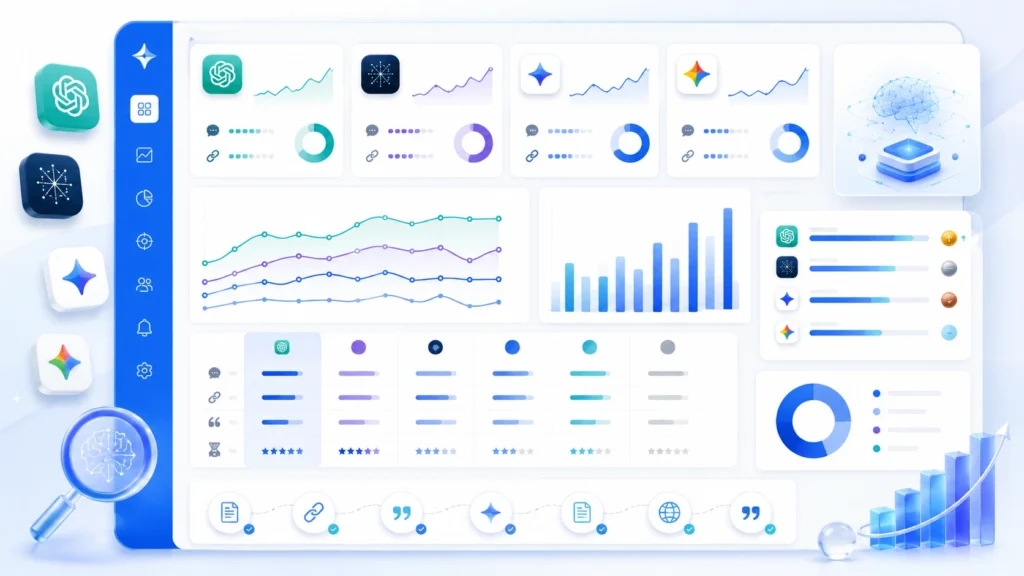
AI search visibility tools dashboard showing brand monitoring across ChatGPT, Gemini, and Google AI Overviews in 2026
AI search visibility tools are now one of the most important pieces of software a marketing team can own in 2026. The way people search has fundamentally changed. Instead of clicking through blue links on Google, millions of users now type questions into ChatGPT, Gemini, Perplexity, and Claude and they trust the answer they get back.
If your brand is not inside those answers, your competitor is.
This guide covers the 8 best AI search visibility tools available right now, explains what each one does well, and shows you how to use them to protect and grow your brand online.
What Are AI Search Visibility Tools?
AI search visibility tools are software platforms that track whether your brand, product, or website appears inside AI-generated answers.
Here is a concrete example. If someone asks ChatGPT:
“What are the best project management tools for small businesses?”
An AI search visibility tool can tell you:
- Does your brand appear in the answer?
- Is your website linked as a source?
- Are competitors mentioned instead?
- Is the tone of the mention positive, neutral, or negative?
- Which web pages is the AI pulling from?
Traditional SEO tools like Google Search Console only show Google rankings and clicks. They cannot see inside AI-generated answers. That is the gap these tools fill.
According to research covered by Nightwatch, AI search tools help brands track mentions in ChatGPT, Perplexity, Google AI Overviews, and other AI-powered search engines — something traditional rank trackers were simply not built to do.
Why AI Search Visibility Matters in 2026?
Let’s be clear about what is actually happening in search right now.
Users are increasingly skipping the results page entirely. They ask an AI tool, read the answer, and act on it without visiting a single website. That means your Google ranking position may be irrelevant if the AI describing your market never mentions your company.
You can read more about AI Impact on Work Week: 7 Powerful Changes Reshaping Jobs in 2026.
Here is what makes this especially urgent for businesses:
AI tools have no obligation to mention you. They mention the brands and pages they have been trained on or that appear in their retrieval systems. If your content is thin, outdated, or uncited across the web, you simply will not appear.
Your competitors can win business before the user ever searches Google. A SaaS company, a local service, or an e-commerce brand that appears consistently in ChatGPT and Gemini answers gains trust before a user even considers visiting a website.
AI mentions are invisible without the right tools. You cannot manually check every AI platform every day. You need automated tracking which is exactly what AI search visibility tools provide.
The 8 Best AI Search Visibility Tools in 2026
1. Otterly AI: Best Overall for AI Brand Monitoring
Otterly AI is one of the most purpose-built AI search visibility tools on the market. It is designed specifically to track brand mentions across AI answer engines, not retrofitted from an older SEO product.
According to Otterly’s own documentation, it monitors visibility across ChatGPT, Perplexity, and Google AI Overviews tracking not just whether you appear, but how often and in what context.
Best for: Small businesses, marketing teams, and SEO agencies that want a clean, focused AI monitoring dashboard.
Key features:
- Brand mention tracking across multiple AI platforms
- Competitor visibility comparison
- Citation source identification
- Alerts when your AI visibility changes
- Share of voice reporting
What makes it stand out: Otterly was built around the AI monitoring use case from day one. That focus shows in the interface and the quality of the data.

2. SE Ranking: Best for SEO Teams Adding AI Tracking
SE Ranking is a well-established SEO platform that has added strong AI visibility features. If your team already uses SE Ranking for traditional keyword tracking, this is the natural upgrade path.
As covered by The Rank Masters, SE Ranking’s AI visibility tools allow users to audit how their brand appears in Google AI Overviews specifically useful for brands where Google remains the primary acquisition channel.
Best for: SEO teams, content agencies, and businesses already invested in traditional SEO workflows.
Key features:
- Google AI Overview tracking
- Keyword-level visibility monitoring
- Domain citation tracking
- Side-by-side SEO and AI visibility data
- Competitor comparison
What makes it stand out: The ability to see traditional keyword rankings and AI visibility in the same platform saves time and makes correlation analysis much easier.
3. Nightwatch: Best for Advanced SEO Professionals
Nightwatch has built a strong reputation among SEO professionals for accurate rank tracking. Its AI search monitoring capabilities extend that accuracy into the AI answer engine space.
Best for: Senior SEO professionals and data-driven agencies that need granular tracking.
Key features:
- AI search mention monitoring
- Multi-platform brand tracking
- Competitor insights
- Historical visibility data
- Performance dashboards
What makes it stand out: Nightwatch bridges the gap between classical SEO performance data and AI visibility metrics giving you a single view of how you are performing across both traditional and AI search.
4. Rankability: Best for Content Teams
Rankability focuses on helping content teams understand not just whether they appear in AI answers, but why and what they can do to appear more consistently.
According to Rankability’s research blog, its AI visibility tools track how brands and pages appear in answers across ChatGPT, Perplexity, Gemini, Claude, and Google AI Overviews.
Best for: Content marketers, SEO writers, and businesses focused on improving content quality for AI discoverability.
Key features:
- AI citation monitoring
- Content optimization guidance
- Brand and competitor visibility tracking
- Prompt-level testing
- Source page analysis
What makes it stand out: The content optimization angle. Knowing that you are invisible is useful. Knowing what to write to become visible is far more actionable.
5. Profound: Best for Enterprise Brands
Profound targets larger organizations with deeper reporting needs. It focuses specifically on how enterprise brands appear inside AI-generated answers at scale.
Best for: Enterprise marketing teams, brand managers at large companies, and agencies managing multiple large clients.
Key features:
- Prompt-level AI answer tracking
- Brand sentiment analysis
- Competitor monitoring
- Enterprise-grade reporting
- Team collaboration features
What makes it stand out: Profound is the tool for when you need to present AI visibility data to a CMO or Board. The reporting depth and customization go well beyond what lighter tools provide.
6. Peec AI: Best for Startups and SaaS Companies
Peec AI is designed for fast-moving growth teams that need to find and close visibility gaps quickly. A visibility gap is when your competitor consistently appears in AI answers for a buyer intent query, and you do not.
Best for: SaaS companies, funded startups, and growth marketing teams.
Key features:
- Visibility gap analysis
- AI answer tracking
- Competitor mention monitoring
- Prompt library management
- Automated visibility reports
What makes it stand out: The gap-focused framing. Peec AI does not just tell you where you appear it tells you exactly where your competitors are winning attention that should belong to you.
7. LLMrefs: Best for Content Publishers and Bloggers
LLMrefs takes a different angle: it focuses on how large language models cite and reference websites, making it especially useful for publishers, bloggers, and content-heavy businesses.
Best for: Content websites, bloggers, SaaS companies with large content libraries, and SEO teams focused on citation building.
Key features:
- LLM citation tracking
- Source page monitoring
- Brand mention checking
- Content visibility reports
- AI attribution insights
What makes it stand out: Citations inside AI answers act like backlinks used to in 2015 they signal authority. LLMrefs helps you understand and grow those citations systematically.
8. Ahrefs and Semrush: Best for Full-Stack SEO + AI Coverage
Ahrefs and Semrush remain the gold standard for comprehensive SEO data. Both platforms have been adding AI visibility features, making them natural choices for teams that need keyword data, backlink analysis, and AI tracking in one place.
Best for: Professional SEO teams, full-service agencies, and enterprise brands with large SEO budgets.
Key features:
- Deep keyword research
- Backlink analysis and competitor intelligence
- Content gap identification
- AI Overview visibility tracking (Semrush in particular)
- Comprehensive competitor monitoring
What makes them stand out: Backlinks and domain authority still influence what AI tools cite. Ahrefs and Semrush let you build the authority that feeds AI visibility, not just track it.
Quick Comparison Table

| Tool | Best For | Primary Strength |
|---|---|---|
| Otterly AI | Small businesses & agencies | Purpose-built AI brand monitoring |
| SE Ranking | SEO teams | AI Overviews + traditional SEO in one |
| Nightwatch | SEO professionals | Advanced tracking with historical data |
| Rankability | Content teams | Content optimization for AI visibility |
| Profound | Enterprise brands | Deep reporting and enterprise scale |
| Peec AI | SaaS & startups | Visibility gap analysis |
| LLMrefs | Content publishers | LLM citation tracking |
| Ahrefs / Semrush | Advanced SEO teams | Full-stack SEO + AI visibility |
How to Choose the Right AI Search Visibility Tool?
The right tool depends entirely on your situation. Here is a simple framework:
You are a small business or solo marketer. Start with Otterly AI or Peec AI. They are focused, affordable, and designed to give you clear answers fast without requiring a data analyst to interpret results.
You run an SEO agency. Look at SE Ranking, Nightwatch, or Rankability. You need white-label reporting, competitor tracking across multiple clients, and keyword-level granularity.
You are a SaaS company. AI visibility is critical for you because buyers constantly ask AI tools for software recommendations. Peec AI’s gap analysis and Rankability’s content guidance are both worth evaluating.
You are an enterprise brand. Profound is the most mature option for enterprise-grade reporting, team access, and stakeholder presentations.
You already use Ahrefs or Semrush. Check their AI visibility features first before subscribing to a separate tool. You may already have what you need.
The single most important question to ask before choosing any tool: “Does this tell me specifically which prompts my competitors are winning that I am not?” If the answer is yes, it is a strong candidate.
AI Search Visibility vs Traditional SEO
These are not competing strategies they are complementary ones. But they track very different things.
Traditional SEO tracks:
- Keyword ranking positions on Google
- Organic click-through rate
- Backlink profile
- Impressions and search traffic
AI search visibility tracks:
- Brand mentions inside AI answers
- Citation sources used by AI tools
- Competitor mentions across AI platforms
- Sentiment of AI-generated descriptions
- Visibility across ChatGPT, Gemini, Perplexity, and AI Overviews
The important thing to understand is that Google itself recommends creating helpful, reliable, people-first content content that serves the reader rather than gaming a ranking system. That same principle now applies directly to AI search. AI tools prefer to cite authoritative, well-structured, genuinely useful content.
In other words: good traditional SEO practice and good AI visibility practice are largely the same thing. The difference is in how you measure success.
5 Practical Ways to Improve Your AI Visibility
Tracking is the first step. Improving is the goal. Here are five things that directly influence how often AI tools mention and cite your brand.
1. Write Content That Actually Answers Questions
AI tools are built to answer questions. If your content does not directly and clearly answer the questions your customers are asking, you will not appear in AI answers — even if you rank well on Google.
Structure your content around real questions. Use clear headings. Give direct answers before going deeper. Avoid filler content that adds length without adding value.
2. Build Genuine E-E-A-T Signals
Google’s guidance on AI-generated content and quality signals emphasizes Experience, Expertise, Authoritativeness, and Trustworthiness (E-E-A-T). These same signals influence what AI tools treat as credible sources.
Practical steps: add real author names and bios, show dates, link to original sources, include screenshots and original data where relevant. These are signals that both Google and AI tools use to assess credibility.
3. Get Your Brand Mentioned on Other Websites
AI language models learn from the web. If your brand appears repeatedly in credible third-party sources — industry publications, review sites, comparison guides, press coverage those mentions feed into AI training and retrieval systems.
Guest posting, PR, and link-building are not just traditional SEO tactics. They are AI visibility tactics too.
4. Use Clear, Logical Content Structure
AI tools extract information more reliably from well-structured content. Use clear H2 and H3 headings. Avoid large walls of unbroken text. Use short paragraphs. Include summary sections and explicit answers near the top of each section.
This helps both your human readers and the AI systems parsing your content.
5. Track, Adjust, and Repeat
AI visibility is not static. The sources AI tools cite change over time as models are updated and the web evolves. Use one of the AI search visibility tools above to monitor your brand on a monthly basis, identify where competitors are gaining ground, and update your content accordingly.

FAQs About AI Search Visibility Tools
They are software platforms that track whether your brand appears in AI-generated answers from tools like ChatGPT, Gemini, Perplexity, Claude, and Google AI Overviews.
Google Search Console only tracks what happens on Google’s traditional results pages. It cannot see inside AI-generated answers. AI visibility tools fill that gap entirely.
Traditional SEO tracks your ranking position in Google’s blue-link results. AI search visibility tracks whether your brand is mentioned inside conversational AI answers — an entirely different measurement with different tactics for improvement.
Final Thoughts
AI search visibility tools are no longer optional for businesses that take digital marketing seriously.
The way buyers find products, services, and information has shifted. ChatGPT, Gemini, Perplexity, and Google AI Overviews are now part of the purchase journey and if your brand is not appearing in those answers, you are losing awareness before the customer ever reaches your website.
The tools covered in this guide from Otterly AI for simple brand monitoring to Profound for enterprise reporting to Ahrefs for full-stack authority building give you everything you need to understand where you stand and what to do next.
Start by picking one tool that fits your budget and team size. Run your core brand and product keywords against the major AI platforms. See where your competitors appear and you do not. Then use that data to guide your content strategy.
Track. Create. Improve. Repeat.