
AI Property Management Automation: Five Workflows With Guardrails
AI Property Management Automation overview
Editorial method: independent educational workflow based on cited official guidance. No sponsored ranking or guaranteed result. Educational content, not legal, housing, emergency, safety, accounting, or property-management advice.
Property management combines routine coordination with high-impact decisions about homes, money, access, and repairs. Automate reminders and routing first; keep eligibility, enforcement, emergencies, and disputes under qualified human control.
Quick answer
Use AI for maintenance intake, document classification, routine updates, invoice preparation, and knowledge retrieval. Define emergency triggers, fair-housing controls, consent, vendor validation, approvals, and complete audit logs.
What makes this workflow reliable
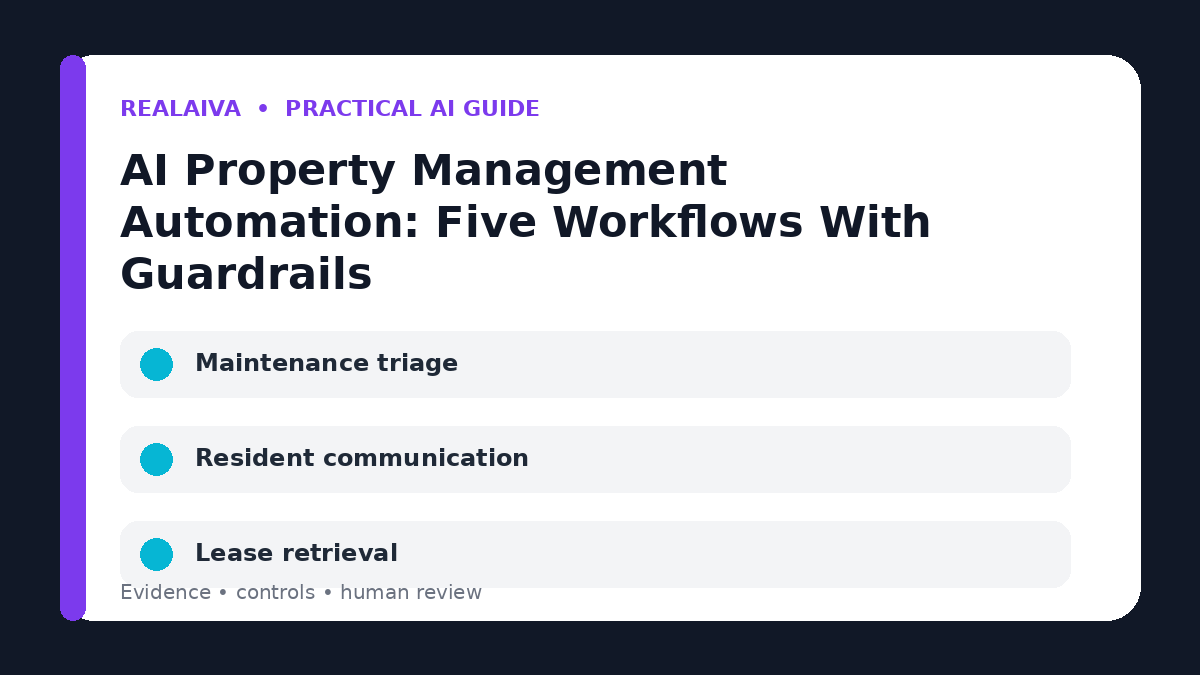
Maintenance triage
Collect location, severity, safety indicators, access permission, and photos without letting a model dismiss emergencies. Apply the rule to a small real example, record what changed, and keep the underlying evidence available to the reviewer. This prevents a polished output from hiding an unsupported assumption.
Resident communication
Use approved facts, clear identity, language access, opt-out, and human escalation. Apply the rule to a small real example, record what changed, and keep the underlying evidence available to the reviewer. This prevents a polished output from hiding an unsupported assumption.
Lease retrieval
Ground answers in the current signed lease and applicable policy, not a generic template. Apply the rule to a small real example, record what changed, and keep the underlying evidence available to the reviewer. This prevents a polished output from hiding an unsupported assumption.
Invoice workflow
Validate vendor, work order, completion, amount, and payment details before approval. Apply the rule to a small real example, record what changed, and keep the underlying evidence available to the reviewer. This prevents a polished output from hiding an unsupported assumption.
Access control
Keys, smart locks, tenant data, and building systems require least privilege and logs. Apply the rule to a small real example, record what changed, and keep the underlying evidence available to the reviewer. This prevents a polished output from hiding an unsupported assumption.
High-impact boundaries
Screening, accommodation, eviction, fees, and disputes need specialist review and lawful procedures. Apply the rule to a small real example, record what changed, and keep the underlying evidence available to the reviewer. This prevents a polished output from hiding an unsupported assumption.
Step-by-step workflow
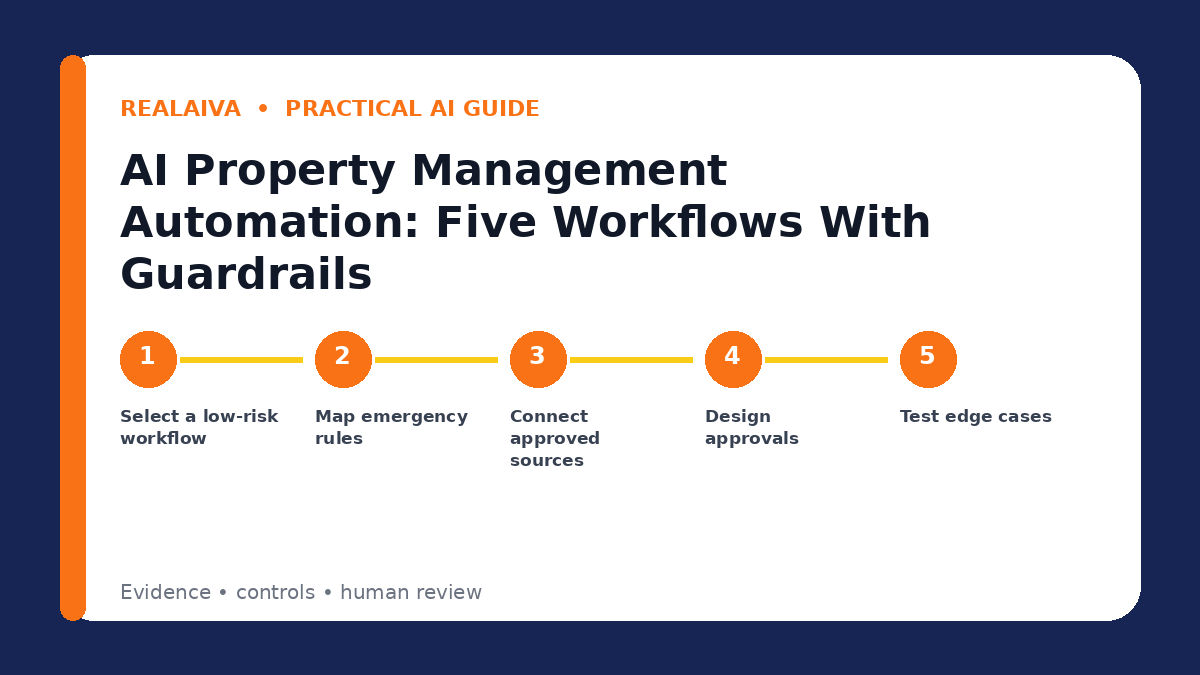
The sequence below is deliberately conservative. It begins with a bounded use case, makes evidence and ownership explicit, and expands automation only after review.
- Select a low-risk workflow: Start with status updates or maintenance classification, not an adverse housing decision.
- Map emergency rules: List conditions that bypass automation and reach on-call staff immediately.
- Connect approved sources: Use current leases, policies, vendor records, and work orders with permissions.
- Design approvals: Require humans for entry, spending, resident commitments, and high-impact actions.
- Test edge cases: Simulate gas smell, water leak, accessibility request, abusive message, duplicate invoice, and system outage.
- Monitor and improve: Review missed emergencies, delays, complaints, false routing, privacy events, and overrides.
Worked example
A resident writes “the outlet is sparking.” The system recognizes an emergency phrase, stops the ordinary troubleshooting flow, displays immediate safety instructions approved by management, and alerts the on-call person. It does not ask the tenant to wait for a model-generated diagnosis.
The important lesson is not the specific tool. It is the control: the team makes assumptions visible, checks the source, and decides who is accountable before the output affects another person or system.
A practical evaluation scorecard
- Accuracy: Are material names, dates, numbers, classifications, and conclusions supported by the source?
- Completeness: Does the output include exceptions, uncertainty, missing information, and the required next action?
- Edit effort: Count correction, formatting, verification, and approval time—not generation time alone.
- Privacy and security: Are data, permissions, retention, sharing, and deletion appropriate to the task?
- Reliability: Does the workflow fail safely when information is missing, conflicting, malicious, or unavailable?
- Accountability: Is a named person responsible for approval, monitoring, exceptions, and rollback?
Score each area from 1 to 5 using the same test cases. Add comments for every score. A total is useful only when a low score in a critical control cannot be hidden by strong convenience features.
Common mistakes to avoid
- Automating adverse decisions: Efficiency does not justify removing due process or qualified review.
- Treating every ticket equally: Safety and habitability signals need immediate escalation.
- Using old lease text: Answers must come from the current agreement and applicable rules.
- Broad smart-building access: Integration convenience can create physical and privacy risk.
How this fits the wider Realaiva library
For broader context, use Realaiva’s AI tools for real estate agents, how to automate business tasks with AI, AI expense tracking tools. These pages cover adjacent decisions, while this guide stays focused on one workflow to avoid repeating the same advice under different keywords.
Authoritative sources and further reading
- HUD Fair Housing Act overview — use the original guidance to verify current requirements and definitions.
- CISA Cybersecurity Best Practices — use the original guidance to verify current requirements and definitions.
- NIST Privacy Framework — use the original guidance to verify current requirements and definitions.
Frequently asked questions
Which workflow should be automated first?
Choose high-volume, low-impact coordination with clear rules, such as receipt acknowledgement or status updates.
What must bypass automation?
Emergencies, safety threats, accessibility requests, disputes, legal notices, and other high-impact situations under your policy.
Can AI answer lease questions?
It can help locate clauses, but the signed lease, current law, and qualified professionals remain authoritative.
Bottom line
Use AI property management automation to improve a defined task, not to manufacture certainty. Start narrow, use authoritative evidence, keep permissions proportionate, measure the complete workflow, and preserve a human decision point wherever an error could materially affect someone.
About The Author






Muito útil. MiniMax H3 text-to-video: MiniMax H3 Video Generator (/). MiniMax H3 Video Generator