
Best AI Tools for Real Estate Agents: Compliant Workflows

AI tools for real estate agents are most useful for drafting, organizing, routing, and monitoring work—not for replacing professional judgment or automating every client interaction. A responsible workflow keeps housing advertising inclusive, obtains the required communication consent, protects client data, discloses material image changes, verifies property facts, and requires human approval before publication or outreach.
Content label: Practical workflow and selection guide. Updated August 10, 2026. The author has real-estate sales experience, but Realaiva did not run a controlled test of the previously listed vendors. This article therefore does not publish conversion, valuation-accuracy, or time-saved rankings. Laws, licensing rules, MLS policies, and consent requirements vary by location; consult the responsible broker and qualified counsel.
Best AI tools for real estate agents: choose by workflow
| Workflow | Useful capability | Human approval | Main risk |
|---|---|---|---|
| Lead intake | Form parsing, duplicate detection, routing, reminders | Consent and assignment review | Discriminatory targeting or unlawful contact |
| CRM follow-up | Draft messages, summarize history, suggest next task | Agent approves communication | Wrong facts, tone, timing, or recipient |
| Listing description | Turn verified facts into a draft | Agent checks every property claim | Fabricated feature or prohibited language |
| Images and staging | Enhancement, decluttering, virtual furniture | Agent compares original and discloses changes | Misrepresentation of condition or dimensions |
| Market research | Organize public records and comparable-property notes | Licensed professional selects and adjusts evidence | Bad data, biased model, or false valuation confidence |
| Meetings and documents | Transcribe, summarize, extract tasks | Participants and agent verify the record | Privacy, recording consent, or omitted obligation |
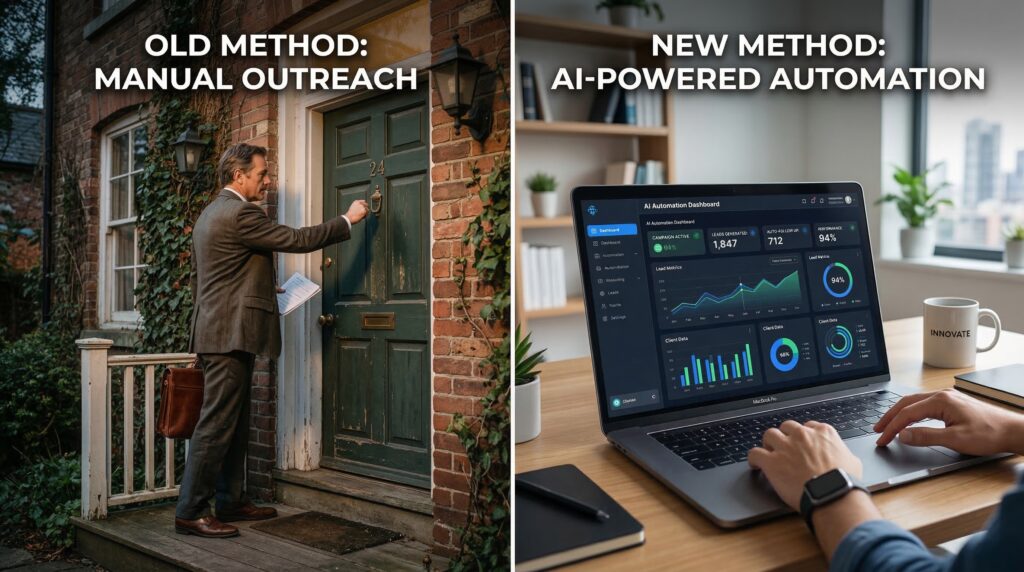
Workflow 1: consent-based lead intake and CRM routing
A defensible lead workflow starts with a clear source and permission record:
- A prospect submits a property form, sends a message, or requests information through a declared channel.
- The system records the source, timestamp, requested property, preferred channel, and exact consent language presented.
- Duplicate detection checks the CRM without overwriting the existing owner or conversation history.
- Routing uses business factors such as location served, language requested, agent availability, and transaction type—not protected characteristics or proxies for them.
- The assigned agent reviews the facts and sends or approves the first response.
- Opt-outs and do-not-contact requests are synchronized across email, SMS, phone, and advertising systems.
HUD states that the Fair Housing Act applies when AI and algorithms are used in housing advertising and tenant screening. An ad platform’s optimization does not remove the advertiser’s responsibility. Review audience criteria, excluded locations, proxy variables, delivery reports, and lead-routing outcomes for discriminatory patterns.
Workflow 2: AI-assisted follow-up without illegal robocalls
Use AI to draft a response from verified CRM facts, not to create unsupervised cold outreach. A safe sequence can be:
| Trigger | Draft action | Approval | Failure path |
|---|---|---|---|
| Requested listing information | Prepare property link and three factual answers | Agent checks availability and facts | If data is stale, pause and verify with source |
| No reply after declared interval | Draft one channel-appropriate follow-up | Check consent and opt-out status | Suppress contact if permission is unclear |
| Viewing booked | Prepare confirmation and access instructions | Agent confirms time and property access | Escalate conflict or cancellation to person |
| Call or meeting completed | Summarize needs and next tasks | Agent corrects sensitive or material facts | Do not update CRM if recording/processing lacked consent |
In the United States, the FCC treats AI-generated voices as artificial or prerecorded voices under the Telephone Consumer Protection Act. Telemarketing robocalls generally require prior express written consent under FCC rules, and other federal and state requirements may apply. The FTC also maintains Do-Not-Call requirements. Do not interpret a social-media comment, purchased list, or old CRM record as blanket permission for automated calls or texts.
Workflow 3: listing descriptions from a verified fact sheet
Create a structured input before asking AI to write:
- approved address and property type;
- bedrooms, bathrooms, area, lot size, and measurement source;
- confirmed renovations with dates and permits where relevant;
- included and excluded fixtures;
- fees, restrictions, disclosures, and source documents;
- approved neighborhood facts from reliable sources; and
- words or claims prohibited by the broker, MLS, law, or advertising policy.
Require the model to use only the fact sheet and mark missing information. The agent should compare the final text with the listing agreement, seller-approved facts, MLS fields, and applicable fair-housing guidance. Avoid language that expresses a preference for or against protected groups, even if a model suggests it.
Workflow 4: virtual staging with an original-image record
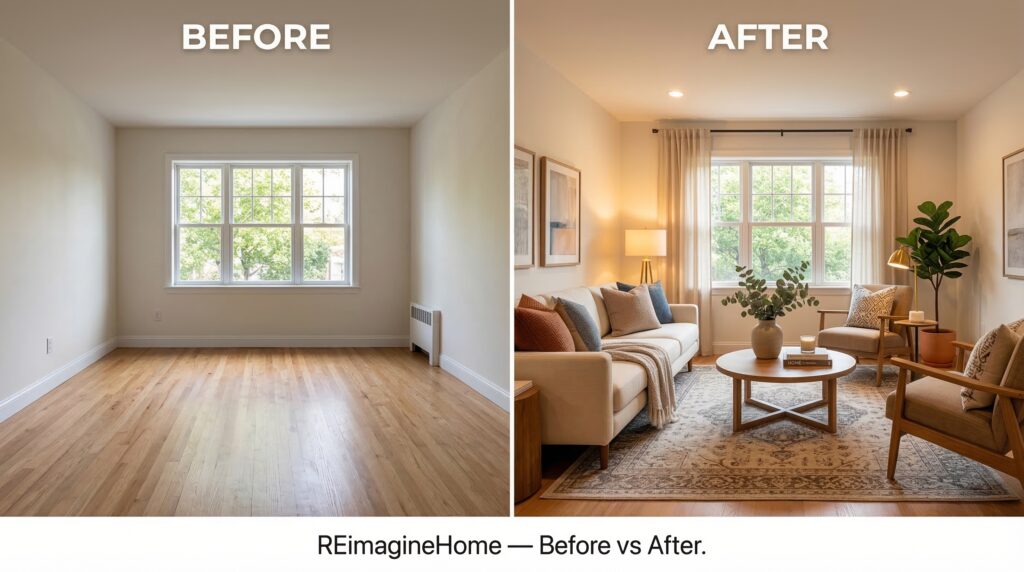
AI image tools can add furniture, change finishes, remove objects, alter lighting, or generate renovation concepts. Those changes may help a viewer imagine a space, but they can also conceal defects or imply features that do not exist.
- Keep the unedited original and the edited version together.
- Do not remove structural defects, permanent obstructions, utility equipment, views, or property boundaries.
- Label virtually staged or materially altered images clearly.
- When practical, show the original adjacent to the staged image.
- Check broker, portal, MLS, photography, and local advertising rules before publishing.
- Use renovation images as concepts, not representations of completed work.
The National Association of Realtors’ risk-reduction guidance advises disclosure when an image has been created, altered, or enhanced using AI and warns against property misrepresentation. Local rules can be more specific.
Workflow 5: market research without pretending AI is an appraisal
AI can organize comparable-property records, summarize changes, calculate price-per-unit measures, and generate questions. It should not be presented as a guaranteed valuation or a replacement for the licensed work required in a jurisdiction.
For each comparable, record the source, status, transaction date, distance, property type, size, condition, lot, material differences, concessions, and reason for inclusion. Separate source facts from agent adjustments. If a model produces a value without showing the records and assumptions, treat the number as unsupported.
A tool-selection and cost framework
| Cost or test | What to record |
|---|---|
| Subscription | Monthly/annual fee, users, contacts, usage limits, overages |
| Implementation | Setup, migration, training, templates, integrations |
| Communication | Email, SMS, calling, number, recording, and consent-management charges |
| Data | Property data licenses, exports, retention, deletion, and portability |
| Reliability | Failed triggers, duplicate records, delayed messages, and outage recovery |
| Compliance | Broker approval, fair-housing review, consent records, image disclosure |
| Outcome | Response time, corrected errors, completed appointments—not vendor-attributed revenue alone |
Test one workflow for a defined period. Compare the same baseline before and after, including review time and errors. A vendor case study or testimonial is not a measurement of your brokerage.
CRM integration checklist
- Which system owns the authoritative contact record?
- Which fields can the AI read or write?
- How are duplicates, spouses, households, and shared properties handled?
- Are source, consent, opt-out, and communication timestamps preserved?
- Can users review and undo an automated update?
- What happens when the CRM, portal, calendar, or communication provider is unavailable?
- Can all data and activity history be exported at termination?
Two free prompts for real-estate workflows
Use approved, nonconfidential information. Do not paste identity documents, financial records, access codes, contracts, or unredacted client data into a general AI service.
Prompt 1: factual listing draft
Using only the verified property fact sheet below, draft a concise listing description. Do not invent amenities, views, renovations, measurements, school quality, safety claims, investment returns, or neighborhood demographics. Avoid language expressing a preference for any type of person. Add a checklist of every material claim the agent must verify before publishing.
Prompt 2: automation risk review
Review the proposed lead workflow below. Return a table with trigger, data used, action, communication channel, consent evidence, fair-housing risk, human approval, failure path, opt-out handling, and audit record. Mark missing consent or policy information as “block launch.” Do not recommend cold AI voice calls.
Methodology, sources, and limitations
Realaiva reviewed the prior article and removed unsupported conversion, engagement, valuation, and time-saved claims; untested product rankings; investment-city recommendations; and unsupervised AI-calling instructions. This guide was fact-checked on August 10, 2026 using HUD’s Fair Housing Act guidance for AI in housing advertising and screening, the FCC’s ruling on AI-generated voices in robocalls, the FTC’s Do-Not-Call guidance, and NAR’s broker risk-reduction guidance. These U.S. sources do not replace local advice or brokerage policy.
Frequently asked questions
What is the best AI tool for a real estate agent?
There is no universal winner. Select by workflow, integrations, data permissions, consent controls, reliability, total cost, and broker or MLS requirements. Test with a defined baseline before expanding.
Can an agent use an AI voice caller?
Rules depend on jurisdiction and purpose. In the United States, AI-generated voices fall within restrictions for artificial or prerecorded voice calls, and telemarketing robocalls generally require prior express written consent. Obtain qualified advice and maintain consent and opt-out records.
Must virtual staging be disclosed?
Disclosure and image rules vary, but clear disclosure is a strong risk-control practice and is recommended in NAR guidance. Never use edits to misrepresent a property or hide material conditions.
Conclusion
Start with one administrative bottleneck and build a reviewed workflow around it. Preserve source facts, consent, opt-outs, original images, audit logs, and human approval. The best real-estate AI system is not the one that sends the most messages; it is the one your brokerage can explain, verify, and stop safely.
Download the AI Ad Poster Prompt Pack
Want a faster way to create ad-poster concepts with AI? Get the prompt pack, adapt the instructions to your product or campaign, and review every generated claim, image, and brand detail before publishing.
About The Author





2 thoughts on “Best AI Tools for Real Estate Agents: Compliant Workflows”