How to Use AI for Stock Market Research Without Trusting Predictions

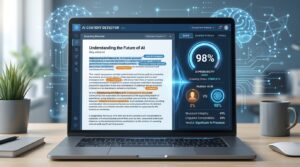
An artificial intelligence brain analyzing financial charts and stock market data.
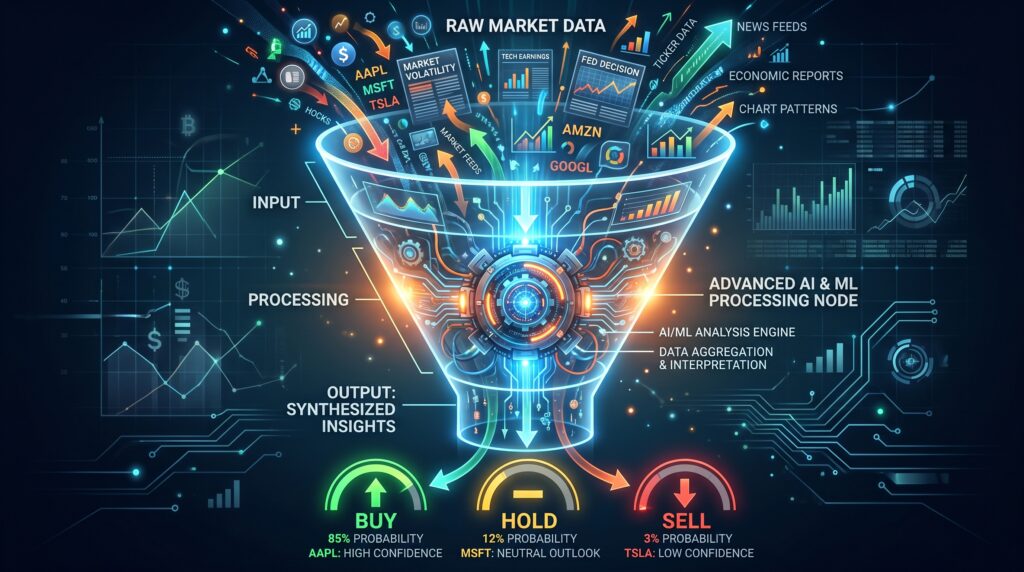
AI stock market prediction is not a reliable way to know which stock will rise next. AI can help investors search filings, summarize long documents, compare reported figures, organize a research checklist, and test a written thesis. It can also invent facts, use stale information, overfit historical data, and turn manipulated online sentiment into a confident but wrong answer.
Content label: Educational research guide. Updated August 10, 2026. This article does not provide personalized investment advice, recommend securities, or promise returns. Investing can result in loss of principal. Verify information with original filings and consult an appropriately qualified professional when needed.
AI stock market prediction: what it can and cannot do
| Reasonable use | Important limitation | Required human check |
|---|---|---|
| Summarize a 10-K, 10-Q, or earnings transcript | The model can omit a caveat or invent a number | Open the source and confirm every material claim |
| Compare revenue, margins, debt, and cash flow across periods | Different accounting periods or definitions may be mixed | Check the tables, footnotes, and units |
| Classify news or customer sentiment | Online content may be false, coordinated, or manipulated | Trace claims to credible primary sources |
| Generate alternative explanations for a price move | A plausible explanation is not proof of causation | Label hypotheses and look for disconfirming evidence |
| Backtest a defined rule | Overfitting, look-ahead bias, and trading costs can create false confidence | Use out-of-sample data and realistic costs |
The useful mental model is research assistant, not market oracle. Prices react to information, expectations, liquidity, positioning, and events that a model may not know. Even a system that describes the past accurately can fail when market conditions change.

A safer seven-step AI research workflow
1. Write the question before opening an AI tool
Define what you are trying to learn. “Will this stock go up?” is too vague and invites unsupported prediction. Better questions include: How has operating margin changed over eight quarters? What does management identify as the principal demand risk? Which assumptions would have to be true for the current valuation to make sense?
2. Start with primary documents
For U.S. public companies, use the SEC’s free EDGAR search tools. Common sources include annual reports on Form 10-K, quarterly reports on Form 10-Q, and material-event reports on Form 8-K. Investor presentations and earnings-call transcripts may add context, but promotional language should not replace filed financial statements.
3. Give the model a bounded source
Paste a relevant excerpt or use a tool that links each answer to the exact document. Tell the model to use only the supplied text, quote the section or page for each observation, and say “not found” when the document does not answer the question. Do not upload confidential financial or personal data to a service unless its terms and your organization’s policies permit it.
4. Separate facts, calculations, and interpretations
Ask for three columns. Facts should reproduce reported information. Calculations should show the formula and inputs. Interpretations should be labeled as hypotheses. This simple separation makes it easier to catch a model that presents a guess as a company disclosure.
5. Challenge the thesis
Ask the model to build the strongest bear case against a bullish thesis and the strongest bull case against a bearish thesis. Then request the evidence that would falsify each view. The purpose is not to let AI choose a side; it is to reveal missing assumptions and confirmation bias.
6. Verify every decision-relevant claim
Open the original document and check the date, currency, units, accounting period, and footnotes. Confirm news with the company, regulator, exchange, or another reliable source. If the claim cannot be verified, remove it from the decision process.
7. Record the decision and risk limit separately
A research summary does not determine position size, diversification, time horizon, tax treatment, or ability to bear loss. Record why a decision was made, what could invalidate it, and when it will be reviewed. Risk limits belong to the investor’s plan—not to a chatbot’s confidence score.
A reproducible company-research scorecard
The following scorecard is a research organizer, not a buy/sell formula. Score each category from 0 to 5 only after documenting the evidence and source date. Do not combine scores from companies with fundamentally different business models without explaining why the comparison is meaningful.
| Category | Questions to document | Primary source |
|---|---|---|
| Business quality | How does the company make money? Is demand concentrated among a few products or customers? | 10-K business and risk sections |
| Financial resilience | What are the trends in cash flow, debt, liquidity, dilution, and margins? | 10-K/10-Q statements and footnotes |
| Execution | Did management meet previously stated operational targets? Were targets changed? | Prior filings and current results |
| Valuation assumptions | What growth and margin assumptions are implied? How sensitive is the result? | Market data plus a disclosed model |
| Risk evidence | What could permanently impair the business? Which risks have become more or less likely? | Risk factors, legal proceedings, 8-Ks |
| Evidence quality | Are observations based on current primary documents or unverified commentary? | Source log |
Keep an evidence log with the metric, value, period, filing type, filing date, source URL, and page or section. That log is more valuable than an unexplained “AI score” because another person can reproduce the work.
How to evaluate an AI investing tool
Do not judge a platform by screenshots, testimonials, or a high win-rate claim. Before paying for or connecting an account to a tool, ask:
- What is the product? A filing search tool, summarizer, screener, alert system, model portfolio, or auto-trading service creates different risks.
- Where does the data come from? Check coverage, update frequency, corrections, licensing, and whether outputs link to original sources.
- How was performance measured? Look for the test period, benchmark, universe, survivorship bias, transaction costs, slippage, and whether results are live or backtested.
- Can the claim be independently checked? A proprietary “AI score” without methodology is not enough evidence.
- Who operates it? Verify registrations and disciplinary history where relevant. Be cautious with unregistered entities that seek trading authority or account credentials.
- What access does it request? Prefer the minimum permissions needed. Understand whether the service can view data, place trades, or withdraw funds.
- How are conflicts disclosed? Determine whether the operator, promoter, or affiliate may own, receive compensation for, or trade the securities mentioned.
FINRA warns that some auto-trading services may exaggerate their use of AI or claim they can predict market moves and optimize profitability. Investor.gov also identifies promises of high returns with little or no risk as a classic fraud warning. Treat urgency, secrecy, guaranteed accuracy, and requests to move money through unfamiliar channels as reasons to stop.
Why AI market models fail
Stale or false inputs
A general chatbot may not have current prices, filings, corporate actions, or news. Even a live feed can contain rumors and manipulated content. A fast answer based on a false input is still false.
Hallucinated facts and citations
Language models generate likely text. They can create a realistic-sounding metric, quotation, filing, or source that does not exist. Links and numbers require direct verification.
Overfitting and leakage
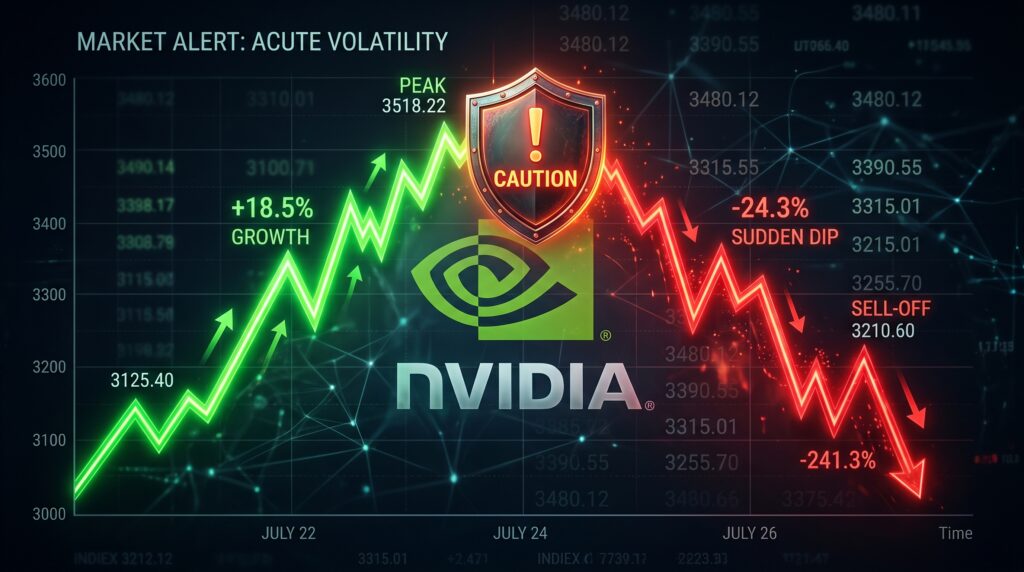
A strategy can appear excellent when it is tuned to historical noise. Look-ahead bias occurs when the test accidentally uses information that would not have been available at the simulated decision time. Survivorship bias can exclude failed or delisted companies. Both can overstate results.
Regime change
Relationships observed during one interest-rate, volatility, policy, or liquidity environment may not continue. Historical correlation does not guarantee a stable trading edge.
Execution reality
A backtest may ignore spreads, fees, taxes, market impact, delayed fills, or limited liquidity. These costs can turn a theoretical profit into a loss.
Two free prompts for source-based stock research
Use these prompts only with a filing or excerpt you are permitted to process. They are designed to organize evidence, not recommend a trade.
Prompt 1: filing evidence table
Using only the filing text below, create a table with: claim, exact reported figure, reporting period, source section, management explanation, and limitation. If an item is not stated, write “not found.” Do not estimate missing values or give a buy/sell recommendation. After the table, list five questions that require another primary source.
Prompt 2: challenge an investment thesis
Review the thesis and source notes below. Separate confirmed facts, calculations, assumptions, and opinions. Identify the three strongest pieces of disconfirming evidence, the conditions that would invalidate the thesis, and any claim that lacks a current primary source. Do not predict a price or recommend a transaction.
Methodology and limitations
Realaiva reviewed official SEC and FINRA investor resources and designed the workflow around traceable primary sources, explicit calculations, thesis challenge, and human verification. We did not test or rank commercial stock-picking products, and we do not publish a model accuracy or return claim. Examples are educational and may not fit an individual’s goals, finances, jurisdiction, or risk tolerance.
Frequently asked questions
Can AI accurately predict stock prices?
No system can reliably guarantee future stock prices. AI can analyze defined data and produce estimates, but unexpected information, bad inputs, overfitting, and changing market conditions can make those estimates wrong.
Is ChatGPT suitable for financial research?
It can help summarize supplied text, create questions, and organize comparisons. It should not be treated as a current market-data source, fiduciary, or substitute for verifying filings and professional advice.
Should I connect an AI tool to my brokerage account?
Understand the operator, registration status, permissions, security practices, fees, conflicts, and ability to place or withdraw funds before granting access. FINRA specifically warns about auto-trading services offered by unregistered entities.
What is the best first use of AI for a beginner?
Start with a low-stakes task: summarize a short section of a filing, then compare every sentence with the original. This teaches both the productivity benefit and the need for verification without risking an automated trade.
Sources and update note
This guide was rewritten and fact-checked on August 10, 2026 using the SEC’s guide to researching investments with EDGAR, Investor.gov’s AI and investment-fraud alert, FINRA’s warning about auto-trading services offered by unregistered entities, and FINRA’s investor bulletin on AI-generated information. Readers should check those sources for later updates.
Conclusion
The right way to use AI in stock research is to narrow the task, provide a reliable source, require citations, separate facts from interpretation, challenge the thesis, and verify every material claim. AI may reduce reading and organization time. It does not remove uncertainty, replace risk management, or turn a forecast into a fact.
Download the AI Ad Poster Prompt Pack
Want a faster way to create ad-poster concepts with AI? Get the prompt pack, adapt the instructions to your product or campaign, and review every generated claim, image, and brand detail before publishing.
About The Author