The 2026 Beijing humanoid robot half marathon just delivered one of the most jaw-dropping moments in the history of both robotics and athletics. On April 19, 2026, in Beijing’s E-Town district, a fleet of autonomous and remote-controlled humanoid machines lined up alongside human runners and crossed the finish line faster than any biological athlete ever has. It seems now, Robotics is taking over the humanity.
This wasn’t a lab demonstration. It wasn’t a controlled experiment. It was a live race, on public pavement, under real-world conditions. And the machines won.
What Happened at the Beijing Humanoid Robot Half Marathon?
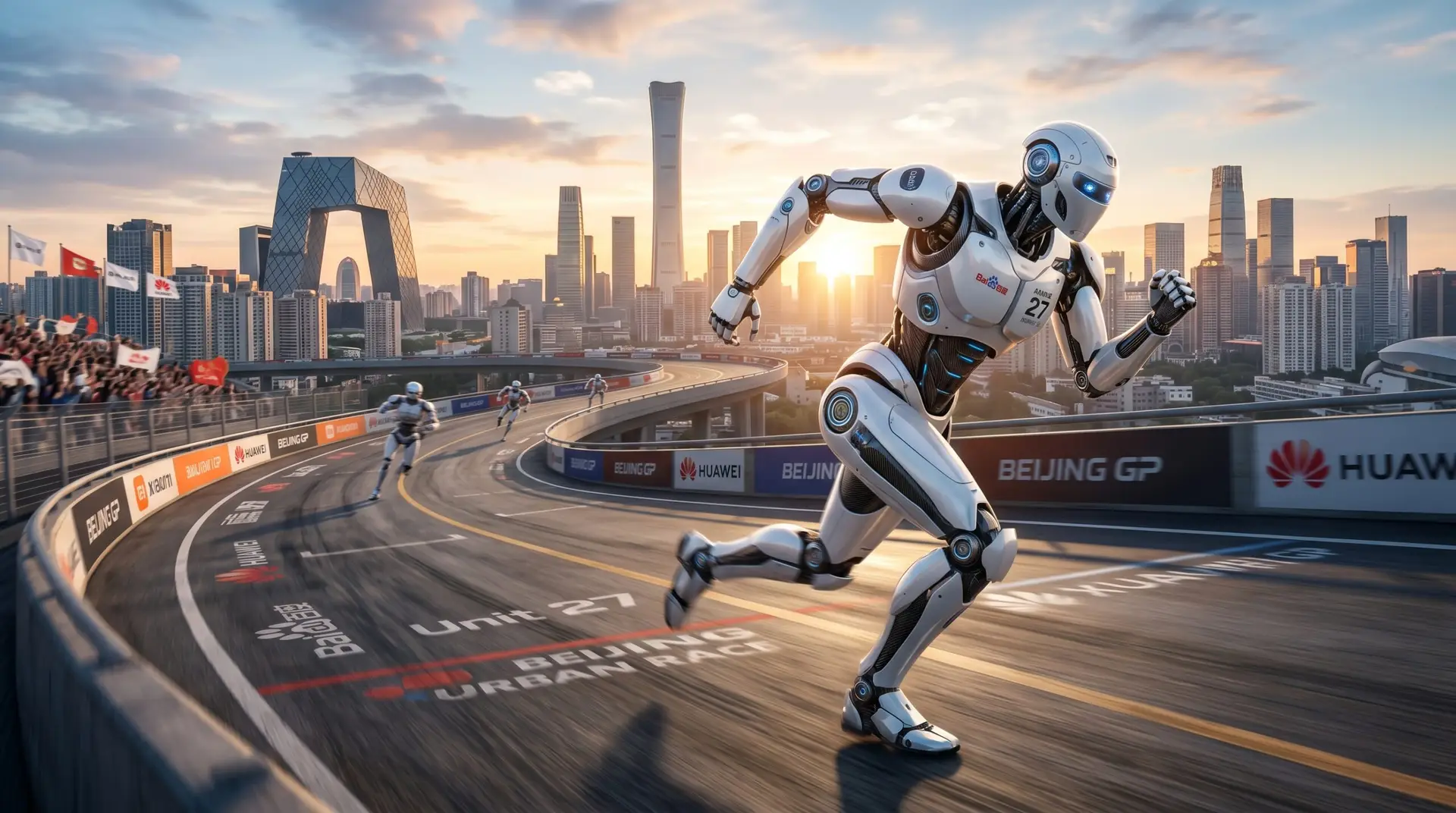
The humanoid robot half marathon in Beijing saw over a dozen robots from competing Chinese tech firms take to a 21-kilometre course side-by-side with human participants. The event, hosted in the Yizhuang economic zone, was designed as a stress test for Physical AI, pushing autonomous systems beyond the sterile safety of factory floors and into unpredictable, dynamic environments.
Honor’s robot, nicknamed “Lightning,” grabbed the headlines by crossing the finish line in a raw time of 48 minutes and 19 seconds. However, the race used a weighted scoring system to level the playing field between remote-controlled and fully autonomous units. Remote-controlled robots were assigned a 1.2 coefficient, reflecting the added difficulty of running without human input. Fully autonomous models received a 1.0 coefficient.
Under this system, Honor’s autonomous navigation team claimed the official top spot with a net time of 50 minutes and 26 seconds, a staggering result that the world was simply not prepared for.
How the Chinese Robot Half Marathon Shattered the Human World Record?
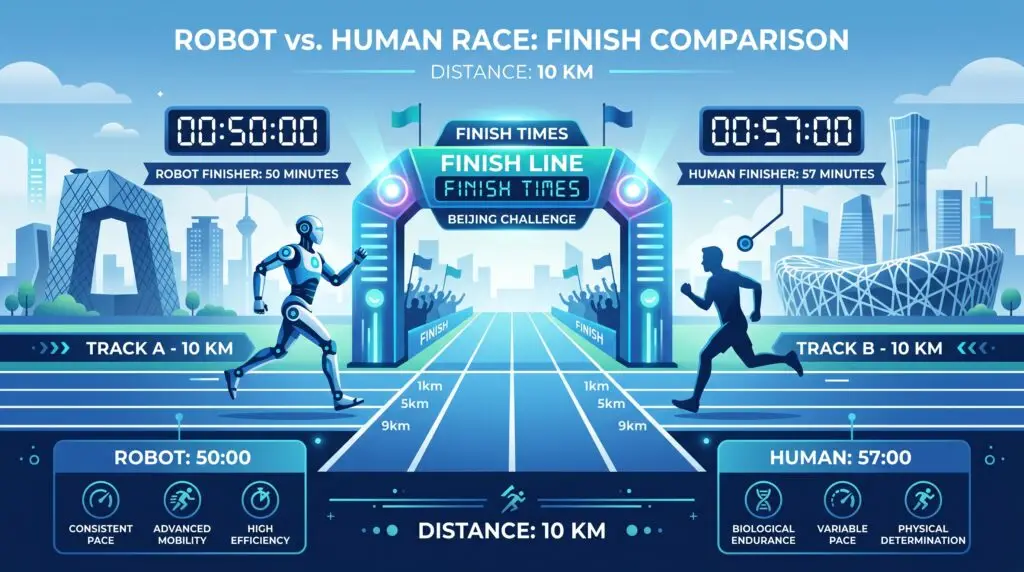
To truly grasp what happened at this humanoid robot half marathon, compare that 50:26 time to the current human world record of 57 minutes and 20 seconds. These machines opened a seven-minute gap over the fastest human endurance athletes alive.
The Best AI Tools for Real Estate Agents in 2026
Seven minutes in a half marathon is not a narrow margin. It is a chasm. At that pace differential, the robots wouldn’t just beat elite runners but they would lap recreational athletes entirely.
What makes this even more remarkable is the trajectory. In the 2025 inaugural Beijing race, the winning robot, “Tiangong Ultra,” completed the course in 2 hours, 40 minutes, and 42 seconds. In just twelve months, Chinese engineers slashed nearly two full hours off the winning time. That is not incremental improvement. That is exponential acceleration.
The Technology Behind Humanoid Robots Outpacing Humans
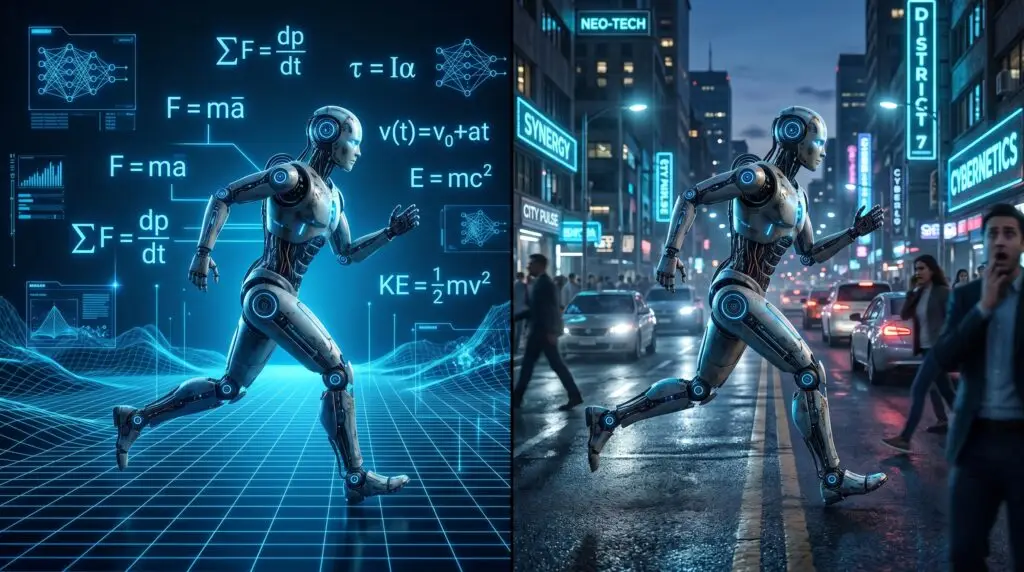
The speed of progress in physical AI humanoid robots running at this level comes down to one fundamental shift: moving from brittle, task-specific programming to general-purpose robot brains and possibly researchers are working on AGI.
Modern humanoid racing robots are trained using “sim-to-real” pipelines. Engineers run millions of simulated trials inside photorealistic, physics-accurate environments platforms like NVIDIA’s Isaac Sim before a single robot touches real asphalt. These simulations are coupled with Vision-Language-Action (VLA) models, which allow robots to perceive their environment, reason about obstacles, and adjust their gait in real time.
Every stride a robot takes in a real race feeds data back into the foundation model. This creates an AI-robot-data flywheel: the more the machines run, the smarter they get. Unlike human athletes, who are constrained by biology and recovery time, robots can iterate on their performance continuously. The fastest humanoid robot half marathon time will keep falling.
Why the Humanoid Form Factor Is the Winning Strategy?
It would be easy to dismiss this event as a novelty that robots built specifically to run a race, purpose-engineered for an artificial competition. That would be missing the point entirely.
The humanoid form factor was chosen deliberately. Humans built the world for human bodies. Our roads, our warehouses, our construction sites, our hospitals all of it is designed around two legs, two arms, and an upright stance. Wheeled robots cannot climb ladders. Robotic arms cannot navigate a staircase. Humanoids can do both.
The intelligence learned on a racecourse like dynamic balance, obstacle avoidance, terrain adaptation transfers directly to factory floors, logistics hubs, and disaster response zones. Beijing’s humanoid robot half marathon isn’t just about running 21 kilometres. It is a public proof-of-concept for machines that will soon work alongside humans in the most demanding physical environments on earth.
What Are the Remaining Challenges for Humanoid Robots?
Despite the extraordinary result at the Beijing humanoid robot half marathon 2026, significant gaps remain. The most paradoxical is what researchers call the “Long Tail” problem: a robot that can run a half marathon in 50 minutes may still struggle to pick up a strawberry without crushing it.
Three barriers stand between today’s machines and full commercial deployment.
First, reliability: crossing the gap between simulation and chaotic real-world conditions requires physics-grounded reasoning, not just pattern recognition.
Second, fine-motor dexterity: haptic intelligence, the ability to feel and respond to tactile feedback remains underdeveloped.
Third, public trust: surveys show that 62% of executives cite societal acceptance as a critical barrier to humanoid adoption. China is addressing this through national standardisation, embedding safety protocols directly into development frameworks.
These are not reasons to be dismissive. A year ago, no humanoid robot had come close to the human world record. Today, they are beating it by seven minutes.
What This Means for Physical AI and the Future of Robotics?
The Beijing humanoid robots dominating the race represents a line in the sand. The last decade of AI was defined by information, large language models, image generators, search systems. The next decade will be defined by action.
Physical AI is the term emerging to describe this shift: systems that do not just process information, but perceive, reason, and move through the physical world. The humanoid robot half marathon in Beijing is the clearest signal yet that this transition has arrived, not as a future possibility, but as a present reality.
For industries that depend on physical labour like manufacturing, logistics, construction, healthcare, the implications are profound. The question is no longer whether humanoid robots will enter the workforce. The question is how quickly, and how society will adapt when they do.
Conclusion
The 2026 Beijing humanoid robot half marathon will be remembered as a turning point in fields of Robotics. A Chinese humanoid robot finishing 21 kilometres in 50 minutes beating the human world record by seven full minutes is not a sports story. It is a civilisation story. The machines are no longer catching up. In at least one measurable dimension, they have pulled ahead and these robots are becoming more Sophisticated day by day.