
The MedTech regulatory updates March 2026 represent the most consequential cluster of simultaneous global changes the industry has faced in years. From the FDA’s sweeping overhaul of its adverse event infrastructure to the EU’s expanded Well-Established Technologies exemptions and the unexpected simplification under the EU AI Act, manufacturers and regulatory affairs professionals face both urgent action items and rare strategic windows. This guide breaks down every major development, what it means for your operations, and what you must do before the next deadline.
FDA AEMS Replaces MAUDE: The End of Fragmented Adverse Event Reporting
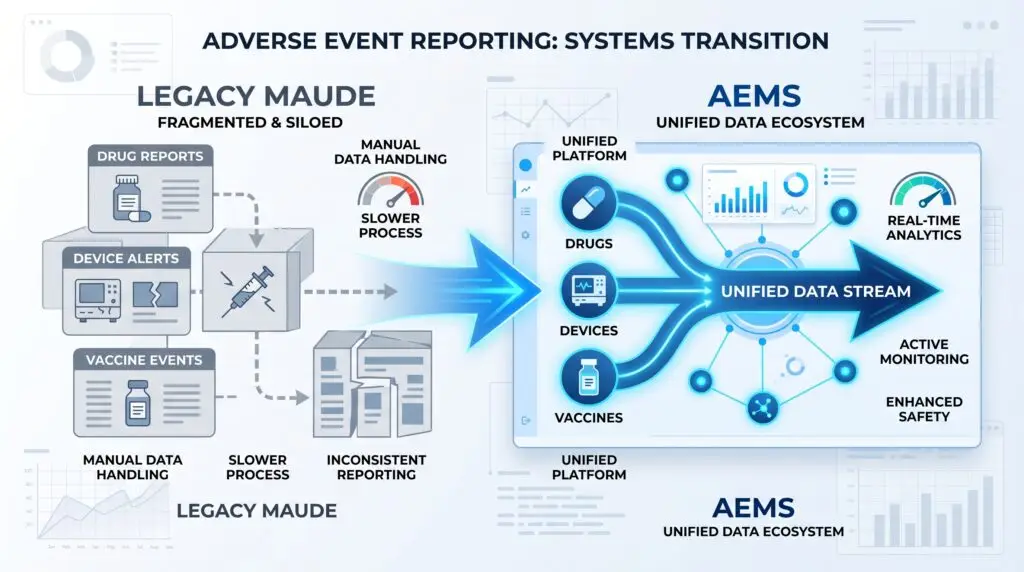
Among the MedTech regulatory updates March 2026, the most operationally disruptive is the FDA’s official launch of the Adverse Event Monitoring System (AEMS) on March 11, 2026. AEMS replaces the decades-old Manufacturer and User Facility Device Experience (MAUDE) database and six other legacy systems including FAERS for drugs and VAERS for vaccines with a single, AI-powered, real-time platform.
The financial case alone is staggering. The legacy network cost the FDA $37 million per year to maintain. AEMS is projected to save $120 million over the next five years while delivering real-time public transparency that MAUDE never offered.
For manufacturers, the consequences are immediate. There are no more batch-reporting windows. Safety signals are published continuously. Combination products such as drug-eluting stents will now have drug and device adverse events monitored in the same system simultaneously eliminating the silo that previously allowed manufacturers to manage these reports independently. Critically, AEMS now serves as a centralized hub for whistleblower submissions, which substantially expands the FDA’s surveillance footprint.
Humanoid Robot Half Marathon: Chinese Robot Smashes Record in 50 Minutes
The FDA’s stated goal is to capture the estimated 80% of adverse events that currently go unreported particularly by physicians, who currently account for a mere 0.09% of MAUDE submissions. AEMS’s redesigned user interface is specifically built to close that gap.
Action required: Audit your post-market surveillance workflows immediately. Signal detection timelines, internal reporting triggers, and escalation procedures must all be recalibrated for a continuous-publication environment.
EU MDR WET List Expansion in MedTech Regulatory Updates March 2026: 70 New Exemptions and a Hidden Trap
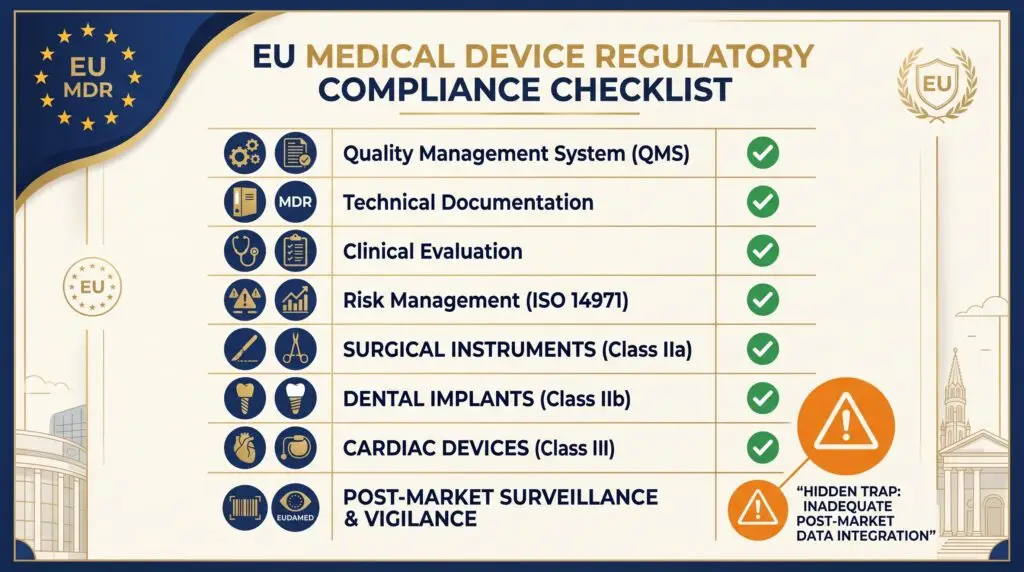
On March 20, 2026, the European Commission issued the delegated regulation expanding the Well-Established Technologies (WET) list under EU MDR and IVDR. Seventy new device categories were added, including surgical instruments, dental implants, and endovascular embolization coils all of which may now qualify for exemption from mandatory clinical investigations under Article 61(4).
This is significant relief for Class III and implantable device manufacturers facing the dual pressure of Notified Body backlogs and clinical investigation costs.
However, the expansion comes with a critical trap that is already being misread across the industry. Under Article 61(5), an exemption from clinical investigation is not an exemption from clinical evaluation. Full clinical evidence including post-market clinical follow-up is still required. The WET list removes the obligation for a prospective clinical investigation only when equivalence and sufficient existing clinical data can be rigorously demonstrated.
The list also suffers from dangerous imprecision. Entries such as “pacing leads” do not differentiate between temporary epicardial wires used in cardiac surgery and permanent neurostimulation leads. Entries for “shunts” carry no anatomical qualifier. Notified Bodies are already expected to challenge broad similarity claims. If your device is not explicitly named, or requires an anatomical qualifier that the list omits, the exemption does not apply automatically.
Action required: Map your portfolio against the expanded WET list with your Notified Body before assuming exemption status. Do not proceed to PMCF planning without confirming eligibility in writing.
EU: AI Act and Digital Omnibus: What MedTech Manufacturers Must Know Now
The Digital Omnibus regulation on AI generated significant surprise across the regulatory affairs community and it was overwhelmingly misread as good news. By migrating MDR and IVDR requirements from Annex I Section A to Section B of the EU AI Act, the European Parliament temporarily removed the direct application of Chapter III high-risk requirements including specific data governance obligations and mandatory human oversight provisions for medical devices classified as AI systems.
In practical terms, your General Safety and Performance Requirements (GSPRs) under MDR/IVDR remain your primary compliance framework. The heavy-lifting of AI Act Chapter III does not apply for now.
Do not treat this as permanent simplification. The European Commission has been granted authority to reinstate AI Act requirements via delegated acts with no advance legislative notice. This “gap period” is a strategic window, not a safe harbor.
Hard deadline to mark in your QMS: August 2, 2028. All Annex I AI systems must be compliant by this date.
Non-animal testing FDA guidance: The FDA’s March 2026 Draft Guidance on New Approach Methodologies (NAMs) is the companion development on the US side. It does not grant permission to remove animal studies. It establishes a four-part validation architecture, Such as Context of Use, Human Biological Relevance, Technical Characterization, and Fit-for-Purpose that imposes a higher evidentiary burden than traditional animal models in many scenarios.
ISO Updates MedTech Manufacturers Cannot Ignore: ISO 14155:2026
The ISO updates MedTech manufacturers received in ISO 14155:2026 constitute the most significant clinical GCP restructuring in six years. The standard now separates risk management into three distinct, auditable categories: device-use risks (managed per ISO 14971), CIP-procedure risks (new category for study-specific procedures outside routine practice), and investigation process risks (data collection, monitoring, randomization).
Failure to track these through separate management pathways and formal escalation trees will result in non-conformance findings at your next clinical audit.
Your March 2026 MedTech Regulatory Compliance Checklist

- Recalibrate post-market surveillance workflows for AEMS continuous reporting.
- Map portfolio against expanded WET list with your Notified Body (get written confirmation).
- Begin QMS alignment for EU AI Act Annex I systems ahead of August 2, 2028.
- Review NAM validation architecture against your current non-clinical strategy.
- Restructure clinical risk management documentation per ISO 14155:2026 categories.
- Flag legacy drug products authorized before 2005 for retroactive ERA assessment
The MedTech regulatory updates March 2026 collectively signal one consistent theme: the era of periodic, silo-based compliance is over. Real-time reporting, integrated AI governance, and auditable risk separation are now the baseline. Organizations that treat this quarter’s changes as a checklist will fall behind. Those that use them to redesign their systems for resilience will define the next decade of MedTech leadership.