Best AI Blog Writing Tools in 2026: Quality Tests

AI blog writing tools should be judged on research discipline, outline quality, factual accuracy, style control, edit effort and originality—not the number of words they generate. Fully automated publishing creates a high risk of generic, unsupported or scaled content.
Content label: Shared-brief quality test and editorial workflow; no fabricated vendor ranking.

The shared article brief
Test every tool with the same assignment: write a guide for small-business owners choosing a first customer-support automation. Audience is non-technical; length target is 1,200–1,500 words; sources are NIST AI RMF, CISA Secure by Design and two vendor-neutral documents; required unique value is a workflow diagram, failure checklist and measurement table; prohibited claims include guaranteed savings or replacing support staff.
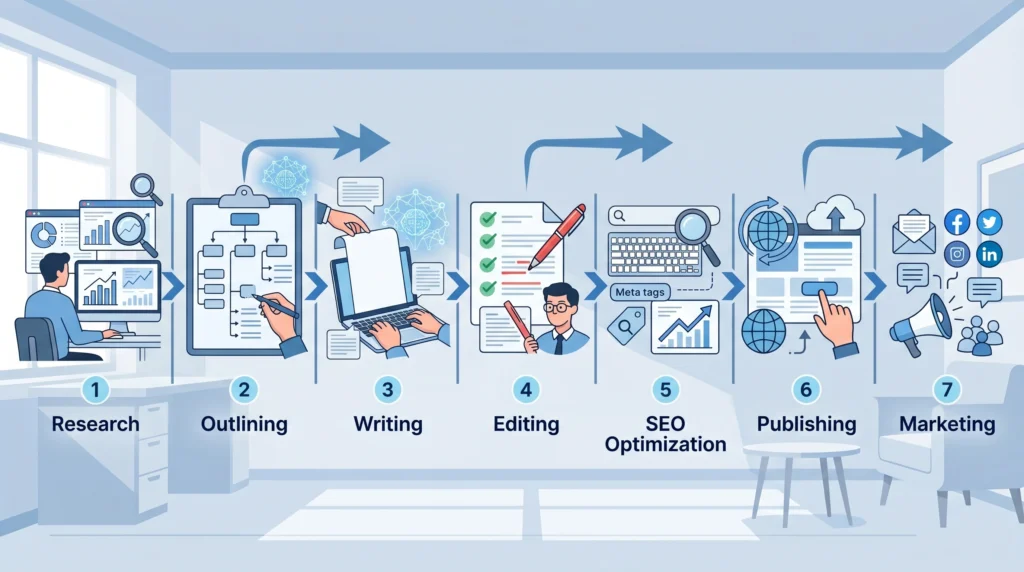
Six-stage blog workflow
- Research: collect primary sources and record claim, URL, date and quotation location.
- Brief: define reader problem, intent, scope, evidence and unique module.
- Outline: order sections around decisions rather than keywords.
- Draft: use AI for bounded sections with supplied sources.
- Fact-check and edit: verify every material claim, remove repetition and add real examples.
- Publish and maintain: add author/reviewer, update date, internal links and revision schedule.

Quality scorecard
| Criterion | Weight | How to test |
|---|---|---|
| Source accuracy | 25% | Open every citation and compare nearby claim |
| Instruction adherence | 15% | Count missed brief requirements |
| Original value | 20% | Assess examples, data, tests or decision tools |
| Structure | 10% | Can a reader act without reading twice? |
| Style control | 10% | Compare with defined voice examples |
| Edit effort | 15% | Record minutes and substantive corrections |
| Transparency | 5% | Method, limits and update date present |
Factual-error log
| Draft claim | Error type | Source result | Correction |
|---|---|---|---|
| Example claim | Unsupported number | No primary evidence | Remove or replace with measured result |
| Example citation | Invented reference | Page does not exist | Use verified source only |
Why automatic publishing is risky
Google’s guidance focuses on value rather than whether a human or AI typed the text, but scaled content created mainly to manipulate rankings violates spam policies. Automated drafts can also repeat competitors, fabricate citations, use outdated prices and erase meaningful author experience.
Human-edit checklist
- Opening answers the reader’s real question.
- Every statistic, law, price and product feature is verified and dated.
- Examples are true, labeled hypothetical or reproducible.
- The page adds a worksheet, test, data set, screenshot or expert contribution.
- Headings describe decisions instead of stuffing keyword variants.
- Images are relevant, licensed and accessible.
- Conflicts, sponsorships and affiliate relationships are disclosed.
- A responsible person approves publication.
Sources, limitations and update note
Reviewed August 10, 2026. Sources: Google people-first content guidance, Google generative AI content guidance, and Google spam policies.
- Tool features and prices can change.
- Vendor claims do not replace independent verification.
- No SEO or employment outcome is guaranteed.
Two free prompts
Prompt 1: “Turn my source packet into an article brief. List reader problem, scope, primary sources, claims to verify, unique evidence module, limitations and a section outline. Do not draft the article yet.”
Prompt 2: “Audit this draft line by line for unsupported claims, invented citations, repetition, generic advice, missing experience and scaled-content risk. Produce a correction table and human-review checklist.”
A publish/no-publish gate
Before publication, an editor should open every source, verify each material claim and review the draft against the original brief. The author then adds a real example, limitation and decision tool that a generic generator would not know. A second pass checks duplication, tone, links, image rights and disclosures. If no responsible person can defend the content, keep it as a draft.
Practical questions before you act
Does Google ban AI-written content?
Google’s guidance focuses on helpfulness and intent, not a blanket ban on a drafting technology. However, scaled unoriginal content made mainly to manipulate search rankings may violate spam policies.
How much human editing is enough?
There is no percentage. The final page needs accurate evidence, original value, clear ownership and a useful answer. Replacing synonyms in a generic draft does not provide that.
Can an AI tool conduct research?
It can help locate and organize material, but every source, quotation and claim must be opened and verified. Prefer primary sources for facts that can change.
How should originality be evaluated?
Look for unique tests, data, interviews, screenshots, examples, worksheets or expert reasoning. A plagiarism score alone does not prove that a page adds value.
When should an old article be updated?
Update when facts, prices, regulations, product availability or reader needs materially change. Record the review date and revise the substance, not only the year in the title.
Example research record
For the support-automation article brief, create one row per material claim. A row should contain the proposed claim, primary source, publication or update date, exact supporting section, whether the wording is fact or inference, and the editor who verified it. If the source only supports “may reduce repetitive work,” the draft must not turn it into “saves ten hours every week.”
Keep rejected claims in the log. They show where the model invented a number, relied on a secondary summary or stretched evidence. This record also makes future updates faster: an editor can revisit the source when a regulation, product or plan changes. For screenshots and original tests, store the date, account, model, input and limitations so a reader can reproduce the result.
Editorial ownership record
- Author and subject familiarity
- Researcher or primary-source checker
- Editor approving structure and clarity
- Specialist reviewer for high-stakes topics
- Next review date and trigger conditions
Download the AI Ad Poster Prompt Pack
Want ready-to-adapt prompts for AI ad-poster concepts? Get the free AI Prompt Pack on Gumroad. Review every generated claim, image, trademark and brand detail before publishing.
About The Author