May 17, 2026

Will Digital Marketing Be Replaced by AI? Best AI Tools for Marketing in 2026

will digital marketing be replaced by AI

Will digital marketing be replaced by AI? If you have searched this question, you are not alone. In 2026, this is one of the most debated topics among students, freelancers, agency owners, and business owners around the world.

I get asked this almost every week: “Should I even bother learning digital marketing if AI is going to take over everything?”

The short answer? No. AI will not fully replace digital marketing. But it is already replacing the lazy parts of it and that difference is everything.

Let me break it down honestly, with no hype, no panic, and no empty reassurance.

1. Will Digital Marketing Be Replaced by AI in 2026?

No, digital marketing will not be completely replaced by AI in 2026.

But here is what I have noticed working in and around digital marketing: AI is not sitting still. It is replacing specific tasks at a fast pace. And that is where the real conversation starts.

Digital marketing is not one job. It is a collection of skills:

  • SEO and keyword research
  • Content writing and editing
  • Paid ads and campaign management
  • Social media marketing
  • Email marketing and automation
  • Analytics and reporting
  • Branding and positioning
  • CRM and lead nurturing
  • Video and visual content

AI can now assist with every single one of these areas. But there is a difference between assisting and replacing.

For example, AI can write a blog post draft in 60 seconds. But without the right search intent, real examples, a clear editorial angle, and E-E-A-T signals, that draft will not rank and it probably will not convert readers either.

Google’s own guidance makes this clear: helpful content must demonstrate real experience and expertise, and should be written primarily for people not to game rankings. (Google for Developers). That standard cannot be met by AI alone.

2. Why People Think AI Will Take Over Digital Marketing?

The fear is understandable and People starts to panic lately. Here is what AI can genuinely do today:

  • Write blog posts, product descriptions, and social captions
  • Generate ad copy variations in seconds
  • Design social media graphics and thumbnails
  • Schedule and publish content automatically
  • Build email sequences and follow-up flows
  • Summarize analytics reports
  • Suggest keywords and content gaps
  • Automate customer support conversations
  • Create video scripts and even rough video drafts

That list is impressive. And it is growing every month.

One data point that shook the industry: Meta reportedly aimed to use AI to fully automate its advertising workflows including campaign creative, audience targeting, and budget recommendations by 2026. (Reuters)

When a platform as dominant as Meta is automating ad creation, it is natural for marketers to worry.

But here is the thing. Automation does not equal elimination. Before AI, a media buyer might spend two days building ad creatives and testing them manually. Now, that same person can generate 30 variations in an hour, test faster, and use the saved time to refine strategy.

That is not replacement. That is leverage.

The marketers I worry about are not the ones using AI. They are the ones doing low-skill, repetitive work and refusing to learn anything new.

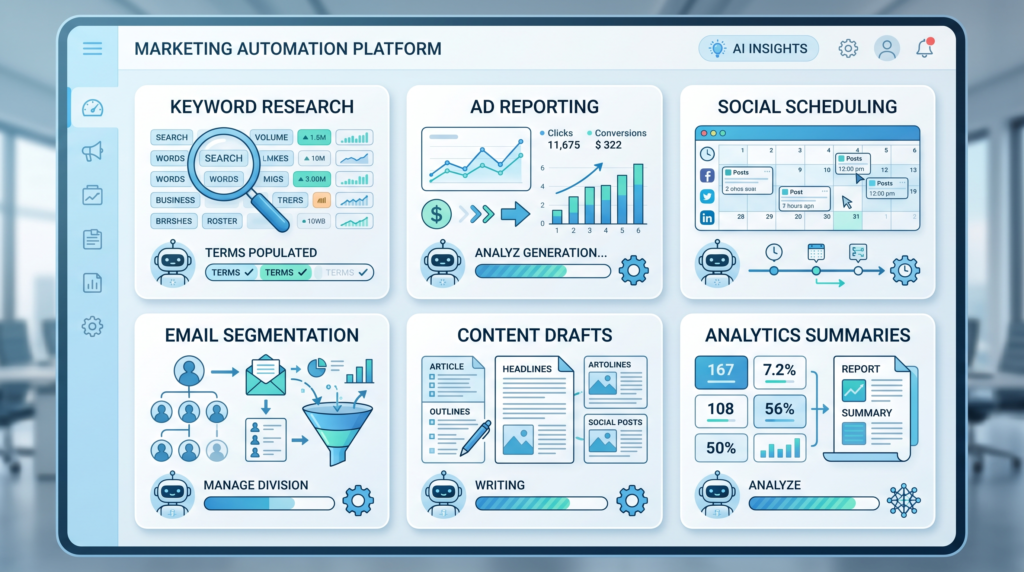
AI tools replacing repetitive digital marketing tasks
AI now handles the repetitive work keyword clustering, ad reporting, email scheduling, and content drafts so marketers can focus on strategy.

3. What Parts of Digital Marketing AI Can Replace?

Let me be direct about where AI genuinely competes with human marketers today.

Basic Content Drafting

AI tools like ChatGPT can produce a readable 1,000-word blog draft in under a minute.

But “readable” is not the same as “rankable” or “trustworthy.” I have reviewed hundreds of AI drafts over the past two years, and the pattern is consistent: they are smooth on the surface and hollow underneath. No real examples. No original insight. No named sources. No experience signals.

The draft is just the start. The value lives in the editing.

Keyword Research Support

AI can brainstorm keyword clusters, identify related questions, and group topics by intent. This used to take hours. Now it takes minutes.

But raw keyword ideas are not a strategy. You still need real search volume data, SERP analysis, competitor gaps, and business context to decide which keywords to actually chase.

Ad Copy Variations

This is one of AI’s strongest areas. Give it your product, your target customer, and your offer and it can generate 20 ad angle variations across fear, curiosity, benefit, urgency, and social proof.

The job of the human marketer shifts from writing to selecting and testing. That is still a skilled job. A bad marketer will pick the wrong ad. A great one will recognize which angle connects with the audience and why.

Reporting and Data Summaries

AI can pull numbers from dashboards, write plain-language summaries, and flag anomalies. This saves real time in agency settings.

But data summaries are not business decisions. A campaign might show lower traffic and still be your best-performing month if lead quality improved. AI cannot make that contextual judgment without human input.

Social Media Scheduling and Captions

AI can plan a full month of content in a few hours captions, hashtags, posting times, carousel outlines.

Consistency is finally achievable for solo operators and small teams. But AI cannot manufacture relevance. If your captions sound like every other brand, the volume of posting will not save you.

4. What AI Cannot Replace in Digital Marketing?

This is where most articles go vague. I want to be specific.

Real Marketing Strategy

Strategy is the skill that sits above every tool.

Strategy answers: Who is this customer? What do they actually fear? Why should they trust this brand instead of the competitor? What message will move them from interest to action?

I have seen businesses generate thousands of AI blog posts and make zero sales. Not because the content was bad on the surface but because there was no strategic thinking behind it. No positioning. No customer pain analysis. No conversion intent.

AI can help you research and produce. It cannot set the direction.

Genuine Human Experience (Google’s E-E-A-T)

Google’s E-E-A-T framework which is Experience, Expertise, Authoritativeness, Trustworthiness is built around content that comes from real people with real knowledge. (Google for Developers)

Experience, specifically, means you were there. You tested the tool. You ran the campaign. You made the mistake and learned from it. AI cannot fabricate that. And Google’s systems are increasingly good at detecting when it is absent.

Here is a real example of the type of insight that only comes from experience:

“The first time I used AI to generate content for a client’s product pages, the rankings actually dropped for six weeks. Not because the content was wrong it was accurate. But it had no brand voice, no specificity, and no customer language. We had to go back and rewrite with real customer testimonials baked in.”

That kind of example builds trust. AI cannot generate it honestly.

Brand Voice

A brand voice is not a tone setting. It is a personality that customers recognize across every touchpoint email subject lines, ad headlines, Instagram captions, customer service replies.

You can prompt AI to write “in a casual, confident, slightly humorous tone” and it will do a decent job. But it will not surprise you. It will not write the line that becomes your brand’s signature.

Client Communication and Business Judgment

If you work in an agency or as a freelancer, your client relationships are your business. No AI tool will tell a nervous client why their campaign is underperforming, manage their expectations during a slow month, or explain why a budget increase makes sense right now.

Those conversations require trust, reading the room, and understanding the client’s business pressure. That is irreplaceable at least for now.

human marketing strategy and AI tools working together
The best digital marketers in 2026 use AI for production and their own thinking for strategy, brand voice, and client decisions.

5. The 9 Best AI Tools for Marketing in 2026

best AI tools for marketing in 2026
From SEO to CRM to video  these are the AI marketing tools actually worth your time in 2026.

The goal is not to use every tool. It is to use the right tools for your specific workflow. Here are the nine categories that matter most with honest opinions on each.

1. ChatGPT: Strategy, Content, and Research

ChatGPT is my most-used tool for first-draft thinking. Not first-draft publishing but first-draft thinking.

OpenAI describes ChatGPT as useful for brainstorming campaign angles, iterating copy, surfacing audience insights, and improving messaging workflows. (OpenAI Academy)

Best for: Content briefs, ad angle brainstorming, customer persona drafts, email flows, script outlines, and pressure-testing messaging.

My honest take: The marketers who get the most from ChatGPT are those who treat it as a junior researcher, not a final writer. Feed it your audience, your product, and your real observations. Then edit heavily. That combination beats pure AI output every time.


2. Canva AI: Design and Visual Content

Canva’s AI tools now include design generation, AI-assisted writing, image generation, background removal, and branded templates. (Canva)

Best for: Social media posts, blog featured images, YouTube thumbnails, pitch decks, and ad creatives.

My honest take: Canva AI has democratized design for non-designers. That is genuinely useful. But for premium brands, the output needs customization. The default AI aesthetic looks competent but forgettable. Spend 15 extra minutes making it yours.


3. HubSpot Breeze AI: CRM and Lead Automation

HubSpot’s Breeze AI agents handle time-consuming work across marketing, sales, and customer service so teams can focus on strategy and relationship-building. (HubSpot)

Best for: Lead qualification, sales follow-up sequences, customer support automation, email workflows, and CRM contact management.

My honest take: Most businesses do not fail because they lack blog posts. They fail because they do not follow up with leads properly. If that describes your business, CRM automation delivers faster ROI than any content tool.


4. Semrush: SEO and AI Search Visibility

Semrush remains one of the most complete platforms for SEO covering keyword research, competitor analysis, backlink auditing, rank tracking, and now AI search visibility monitoring. (Semrush)

Best for: Keyword research, content gap analysis, technical SEO audits, competitor tracking, and SERP position monitoring.

My honest take: AI alone cannot replace SEO data. Knowing what people actually search with real volume, difficulty, and intent signals requires a proper tool. I would not launch a content strategy without at least three months of Semrush data behind it.
AI Search Visibility Tools: 8 Best Picks in 2026 to Track Your Brand in ChatGPT & Gemini


5. Zapier: Marketing Automation and Workflow

Zapier connects thousands of apps and automates workflows that would otherwise require manual work across platforms. (Zapier)

Best for: Lead form automation, CRM updates, email alert triggers, content publication workflows, and multi-tool AI pipelines.

My honest take: Zapier is where individual AI tools become a system. A lead fills a form → data goes to CRM → AI summarizes the lead profile → email sequence triggers → sales team gets a Slack notification. That kind of connected automation is where real time savings happen and most small businesses are not using it. AI Impact on Work Week: 7 Powerful Changes Reshaping Jobs in 2026


6. AI Image Generators: Visual Content at Scale

AI image generators (such as tools like Midjourney, Adobe Firefly, and DALL-E) can produce blog images, ad concept visuals, thumbnails, and brand graphics without a professional photographer or designer.

Best for: Blog featured images, Pinterest graphics, YouTube thumbnails, ad concept visuals, and website hero images.

My honest take: Use AI images to support genuine content not to fabricate results, fake before/afters, or manufacture authority. Misleading visuals erode trust faster than they build it.


7. AI Video Generators: Short-Form and Explainer Content

AI video tools can help create faceless videos, product explainers, social media shorts, and ad concepts without expensive production.

Best for: TikTok, Instagram Reels, YouTube Shorts, product walk-throughs, and training content.

My honest take: AI video tools save time on production, but they cannot save a weak concept. The hook, the message, and the pacing still need a human brain behind them. I have seen polished AI videos flop because the idea was boring and I have seen low-production human videos go viral because the message hit a nerve. Invest in the idea first.


8. AI Email Marketing Tools: Sequences and Personalization

AI email platforms can generate subject lines, build nurture sequences, segment audiences intelligently, and personalize campaigns at scale.

Best for: Welcome sequences, cart abandonment recovery, lead nurturing, re-engagement campaigns, and newsletter ideation.

My honest take: Email is still one of the highest-ROI channels in digital marketing. AI makes it faster. But personalization only works if it feels real not like a mail-merge template. The best AI email sequences I have reviewed still had a human voice shaping the emotional flow.


9. AI Social Media Tools: Planning and Consistency

AI social media tools help with content calendars, caption generation, hashtag research, carousel outlines, and performance analysis.

Best for: Content calendar planning, batch caption creation, short-form video script outlines, and post-performance analysis.

My honest take: AI makes consistency achievable. But consistency alone does not build an audience. Taste does. You still need to know what your specific audience finds useful, funny, relatable, or worth sharing. AI can produce volume. Only a human can make something worth stopping the scroll for.

6. Will AI Replace Digital Marketing Jobs?

Some jobs, yes. Others, absolutely not.

Jobs facing the most pressure from AI:

  • Basic content writers producing generic articles with no expertise
  • Low-skill SEO writers who copy-paste without strategic understanding
  • Simple graphic designers using only preset templates
  • Ad operators who only duplicate campaigns without testing or optimization
  • Data entry and basic reporting assistants

Jobs that AI is actually making more valuable:

  • SEO Strategist
  • Content Strategist and Editorial Director
  • AI Marketing Manager (this role barely existed three years ago)
  • Performance Marketing Strategist
  • Conversion Rate Optimization Specialist
  • Brand Strategist
  • Marketing Automation and CRM Specialist
  • Analytics and Insights Manager
  • Creative Director

The distinction is simple. If your work is doing tasks, AI competes with you. If your work is thinking, deciding, testing, communicating, and improving, AI becomes your most useful assistant.

7. Skills Digital Marketers Must Have in 2026

SkillWhy It Matters in 2026
AI PromptingPoor prompts create generic output. Great prompts create usable drafts and strategic ideas.
SEO StrategyKnowing keywords is not enough. You need topical authority, search intent, and technical fundamentals.
Data AnalysisUnderstanding what the numbers actually mean — not just reading them — is increasingly rare and valuable.
Content EditingAI can write. Humans must edit for accuracy, voice, and genuine usefulness.
Brand PositioningIf your brand sounds like everyone else, AI will amplify that problem at scale.
Marketing AutomationConnecting tools into workflows saves hours and improves lead conversion rates.
Customer PsychologyMarketing is about people. AI can process behavioral data, but empathy and persuasion still need a human.

8. How Smart Businesses Are Using AI in Marketing?

The businesses doing this well are not replacing their marketing teams with AI. They are restructuring how the team works.

A practical AI-powered marketing workflow looks like this:

  1. Human sets the strategy: audience, offer, channel, message, positioning
  2. AI assists with research: keywords, competitor content, trend analysis
  3. Human validates search intent: real-world business context that AI cannot know
  4. AI creates a content draft: structure, initial copy, headline options
  5. Human adds experience and specific examples: the E-E-A-T layer AI cannot fabricate
  6. AI generates visual variations: images, thumbnail options, ad creative tests
  7. Human reviews quality and brand accuracy: final editing, fact-checking, tone correction
  8. AI summarizes campaign performance: weekly reporting, anomaly detection
  9. Human makes business decisions: budget changes, channel shifts, offer pivots

This workflow is not about trusting AI blindly. It is about knowing exactly where AI adds speed and where human judgment adds value.


9. Final Verdict: Will Digital Marketing Be Replaced by AI?

Digital marketing will not be fully replaced by AI But it will never be the same either.

AI is replacing the slow, the repetitive, the generic, and the lazy. It is raising the floor which means average work is now easier to produce than ever. And it is raising the ceiling because skilled marketers armed with AI can do more than ever before.

The professionals at risk are not the ones learning AI. They are the ones producing surface-level work and calling it strategy.

My final position is this: AI will not replace digital marketers. But digital marketers who use AI intelligently will replace those who do not.

If you are building a career in digital marketing right now, do not let this question paralyze you. Learn the tools. Understand the strategy behind them. Develop your thinking, your taste, and your ability to communicate clearly.

Those skills do not go out of style. They become more valuable as AI makes everything else a commodity

FAQ’s

Will digital marketing be replaced by AI completely?

No. AI can replace repetitive tasks like basic content drafting, ad variations, and data reporting. But it cannot replace marketing strategy, human creativity, brand judgment, client communication, or real-world experience. The field is changing not disappearing.

Is digital marketing still a good career in 2026?

Yes. Digital marketing is still a strong career choice in 2026. But the entry point has risen. Beginners who only know basic tools will struggle. Those who combine AI literacy with genuine strategic and analytical skills will find growing demand for their work.

What digital marketing jobs are safest from AI?

Roles that require strategic thinking, client relationships, creative judgment, or business decision-making are most protected. SEO Strategist, Brand Strategist, Performance Marketing Manager, CRM Specialist, and AI Marketing Manager are all roles with a strong future.

About The Author

Leave a Reply

Your email address will not be published. Required fields are marked *