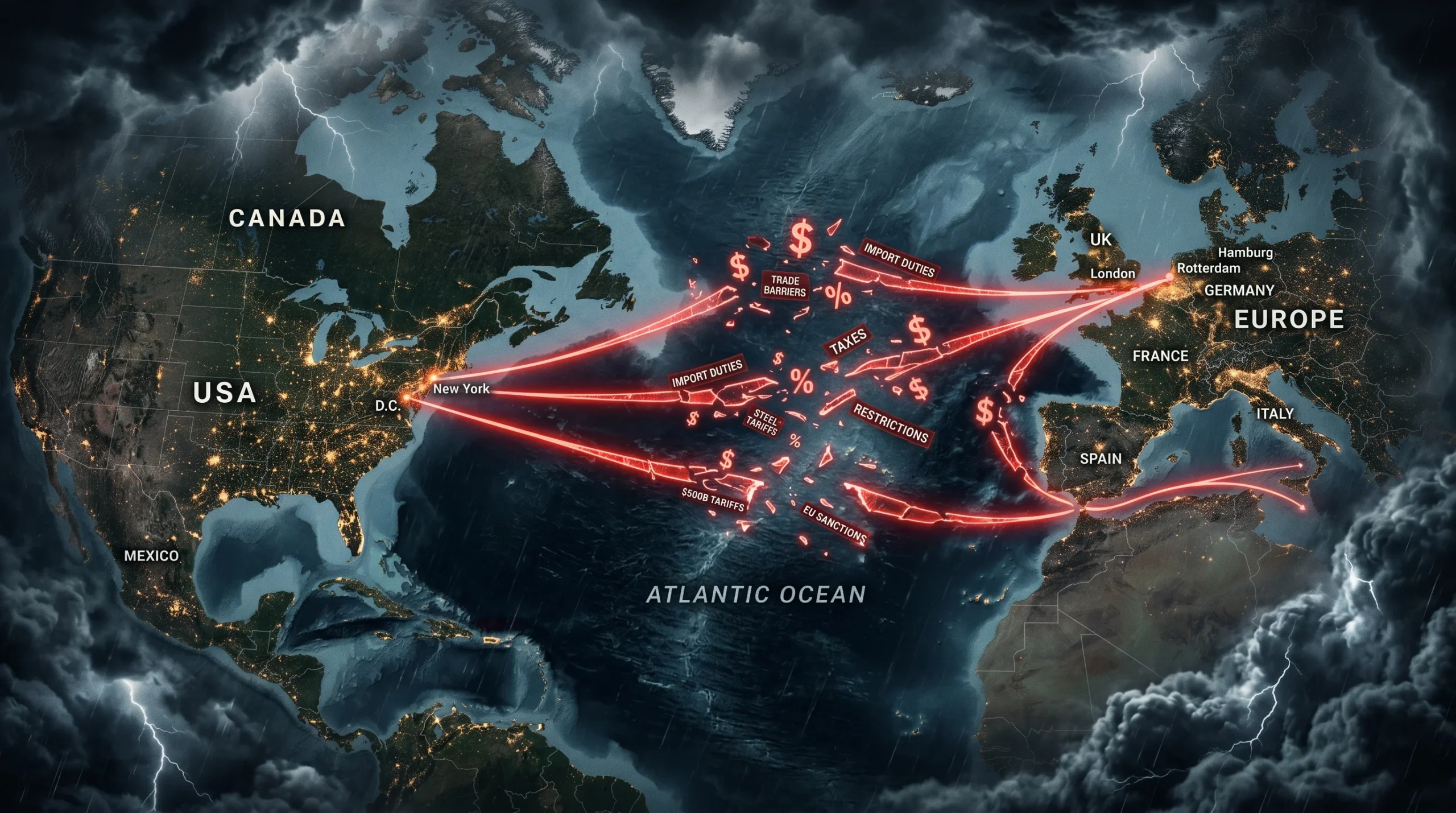
US-Europe relations have entered one of the most turbulent chapters since the Cold War. In 2026, a collision of aggressive American tariff threats, a landmark Supreme Court ruling, China’s industrial surge, and Europe’s own regulatory contradictions has pushed the transatlantic alliance to a breaking point. For investors, policymakers, and global businesses, understanding where us-europe relations stand today and where they are headed has never been more urgent.
The Supreme Court Steps In: A Turning Point for US-Europe Relations

On February 20, 2026, the U.S. Supreme Court delivered a 6-3 landmark ruling in Learning Resources, Inc. v. Trump that fundamentally altered the legal architecture of transatlantic trade. The court struck down the White House’s use of the International Emergency Economic Powers Act (IEEPA) to impose “reciprocal” tariffs, a move that had directly threatened us-europe relations.
By invoking the “major questions” doctrine, Chief Justice Roberts reaffirmed that taxing authority rests with Congress, not the executive branch. For European leaders monitoring us-europe relations news today, this ruling delivered a rare moment of legal clarity. The decision significantly weakens the foundation for any future tariff escalation driven by presidential decree alone.
Following President Trump’s speech today on trade priorities, analysts noted that the ruling has effectively neutered the administration’s most aggressive trade leverage tool.
Strait of Hormuz Blockade Fuels Global Energy Crisis & Sticky Inflation in 2026
The Greenland Gambit: How Territory Became a Trade Weapon in US-Europe Relations 2026?
At the center of deteriorating us-europe relations in 2026 is what analysts are calling the “Greenland Gambit.” The Trump administration threatened a 10% tariff on eight European nations including Denmark, Germany, and the United Kingdom as economic leverage to force the purchase of Greenland. Trump do this on Purpose to maintain it’s Artificial super power in the world.
With a scheduled escalation to 25% by June 2026, this approach represents the weaponization of the global economic system in ways previously unimaginable in modern diplomacy. For those tracking us-europe relations Greenland specifically, the SCOTUS ruling has placed this entire strategy in immediate legal jeopardy.
European leaders are now banking on what insiders call the “Taco moment” Trump Always Chickens Out betting that the administration will reverse course as its legal foundations evaporate. As governors meet with President Trump to discuss domestic economic fallout, allied capitals are quietly fortifying their own trade countermeasures.
Europe’s Trade Arsenal: From “Bazooka” to Quick-Fire Option
Brussels has not been passive in the face of worsening us-europe relations. The EU has activated two key defensive tools. The first is the Anti-Coercion Instrument (ACI) Europe’s so-called “Trade Bazooka.” Originally designed to counter China’s economic pressure on Lithuania, the ACI can target U.S. crypto, tech, and aviation sectors. However, it takes roughly six months to trigger.
The faster option is the reactivation of €93 billion in suspended tariffs on bourbon, aircraft, and soybeans. (European Commission Trade) These can be deployed within 24 hours of any U.S. escalation. For businesses concerned about an economic blackout scenario, where transatlantic trade essentially freezes this quick-fire mechanism is Europe’s most credible near-term deterrent.
China Shock 2.0: The Hidden Threat Behind US-Europe Relations Headlines
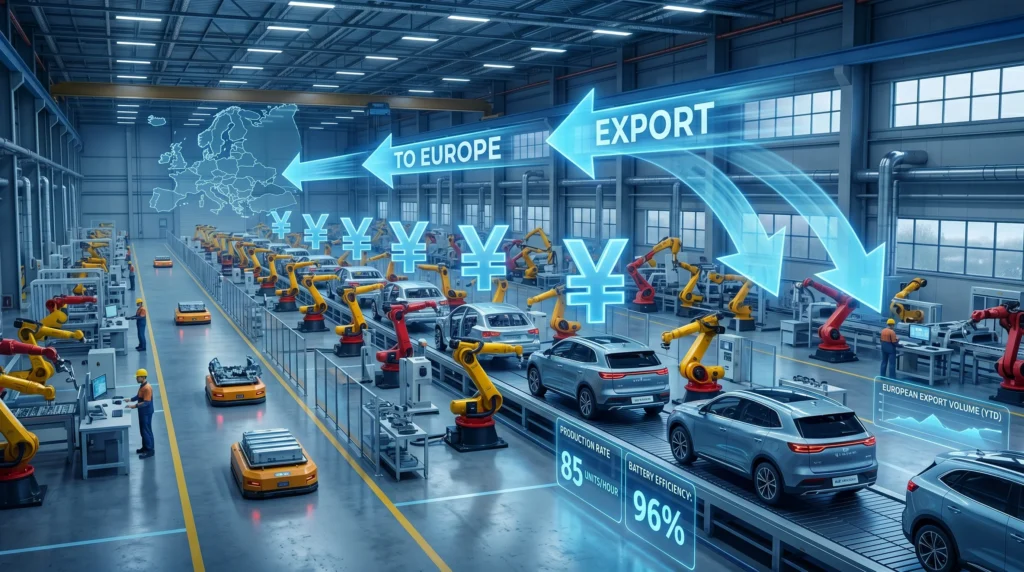
While the Washington-Brussels standoff dominates headlines, a quieter storm is coming from Beijing. China’s global trade surplus exceeded $1 trillion for the first time in 2025, and the Yuan recently hit a decade-low of 8.22 against the Euro. This currency weakness is turbocharging Chinese exports into European markets at historic speed. I’m not kidding, China will takeover the whole European Economy sooner.
The data tells a stark story:
- Industrial robots: A 171% export surge to the EU, with prices plummeting 31% due to the weak Yuan.
- Integrated circuits: An 84% volume increase year-on-year.
- Electric vehicles: Exports more than doubled, with Chinese firms steadily gaining market share.
As China cancels US pork imports in retaliation to American trade pressure, it simultaneously floods European markets with discounted industrial goods. This “China Shock 2.0” strikes directly at the core manufacturing sectors that eastern European countries and northern European countries have increasingly relied upon for economic stability sectors like automotive, machinery, and electronics.
Europe’s Regulatory Paradox: Innovation Gap Widening in US-Europe Relations
One of the deepest contradictions in current us-europe relations is Europe’s self-inflicted innovation deficit. While the EU’s “Competitiveness Compass” pledges a 25% cut in administrative burdens, European regulators continue layering on new mandates at the same time.
The AI investment gap is stark: the U.S. “Stargate” (Half of the money taken from Gulf countries for this) project represents a $500 billion infrastructure commitment nearly 250 times larger than the EU’s comparable “AI Factories” budget. With trump russia tensions reshaping global geopolitical alignments, and russia news continuing to unsettle eastern Europe, the bloc can ill afford to handicap its own innovators.
Klarna CEO Sebastian Siemiatowski has highlighted how incumbent banks exploit broken APIs and deliberate friction to stifle fintech competitors while regulators remain focused on new compliance frameworks. Europe’s economic systems are struggling to adapt fast enough to compete in a world driven by artificial intelligence and digital infrastructure.
What’s Next for US-Europe Relations in 2026 and Beyond?
The fracturing of us-europe relations is not a temporary diplomatic spat it is a structural shift. The post-war trade order, built on multilateral rules and shared institutions, is giving way to economic coercion, currency wars, and judicial pushback.
The critical question for 2026 is whether the EU can resolve its internal innovation friction before external pressures from both Washington and Beijing permanently erode its competitive position. The “Brussels Effect,” Europe’s ability to set global standards through market size alone, faces its greatest test yet. If Europe cannot adapt, it risks becoming the world’s most regulated market rather than its most competitive one.
In my opinion, Europe needs to build their own products and promote them locally; they don’t need to depend on the USA, especially after the USA-Iran war when America is fighting for another country for nothing and breaking the economy of all countries. Europe should import less from the USA and not support them and, in the meantime, rely less on China also, as they are dominating the market and raw materials in China are too much, so they make things fast and cheaper, whereas for Europe, the raw material is too expensive; companies can’t afford it to build cheaper things.